70 |
Oilfield Technology
May
2016
control at peak profitability, what are the chances of another disaster
occurring when time and resources are at a premium? And, if the oil
industry took a financial and reputational hit from such a failure in
boom times, what impact might it have on today’s already weakened
market?
As many have said over the past several months, those who will
best weather the current stormare those who use the downturn as an
opportunity for reflection followed by innovation. The 2010 incident
had similar potential to act as a tipping point for well control, and yet it
failed tomotivate real industry wide change to conventional methods.
Today, as the tolerance for risks and errors shrinks, the industry has no
choice but to react to the flaws and failures of legacy technologies in a
meaningful way. Now is the time tomake the changes that the industry
failed tomake following the 2010 incident, and tomove to amore
reliable solution.
Well control inthe21
st
century
Drilling underwent a fundamental change – both in theory and in
practice – at the turn of the millennium. As operators moved from
shallow fields to gradually deeper waters in the early 2000s, blowout
preventer (BOP) stacks moved to a few thousand feet below the
surface. A decade later, when ultra-deepwater drilling became the
norm, the BOP moved further to as much as 10 000 ft below the drilling
floor. However, aside from the progression into greater water depths,
well control methodology remained basically unchanged since the BOP
was first invented. This conventional arrangement, when applied to a
deepwater environment, leaves rig equipment and personnel largely
unprotected.
No large-scale changes weremade to counter this new risk. During
the industry upswing, companies worked to prolifically explore and
develop deepwater fields. As issues arose, primary focus was placed on
troubleshooting existing conventional techniques rather than initiating a
deep root-cause analysis on newways to address the technical demands
of deepwater environments.
Then, in 2010, a single catastrophic incident spurred the US
government to respond with new regulations and a heightened
sensitivity to offshore drilling operations. These new regulations
includedmandates for additional safety measures, such as more shear
rams on BOPs.
While the new requirements were well intentioned, they focused on
multiplying the number of backup contingencies rather than addressing
the original problem. An analogy to an everyday safety device helps
to illustrate the problemwith this approach. Imagine if automobile
manufacturers, in an effort to improve the braking capability of cars,
added a second, third, and fourth set of brakes. This may or may not
have prevented any accidents, but it almost certainly would not have
been as effective as what automakers actually did: invent anti-lock
brakes.
Fast forward to today. The steady climb in the deepwater rig count
seen through 2014 has reversed. Instead of being hungry for growth,
operators are now anxious to discover ways to improve efficiency and
increase return on capital employed. With greater attention placed on
drilling economics comes increased visibility on the well control process
– and the flaws that have for too long been overlooked.
The events of 2010 exposed the health, safety, and environmental
risks of deepwater drilling. The recent slide in oil prices, and industry
profits, has revealed the economic costs of ineffective well
control processes. All parties – fromoperators to contractors to
government bodies – aremotivated to question the status quo
and shift to a new drilling paradigm.
Blindspots intheexistingparadigm
Conventional well control is based on a relatively simple
framework with a straightforward, linear progression: Failure
of the primary barrier prompts the driller to close the BOP in
order to isolate the well. Once the BOP is closed, a series of
steps is followed to circulate the influx out of the wellbore and
prepare the mud to regain overbalanced conditions.
When executed swiftly
and accurately, this process
has proved successful in
preventing further escalation
of well control events.
However, this standard
progression also has inherent
flaws, including the lag time
between the occurrence of
an influx and the shutting
of the BOP, caused by many
unpredictable human and
mechanical factors. In land
wells, the typical rig has
limited pump capacity, a
shortage of redundant or
spare equipment, weaker
casing shoes, and in
general less-experienced
crews – challenges that
are further compounded
in large-diameter and
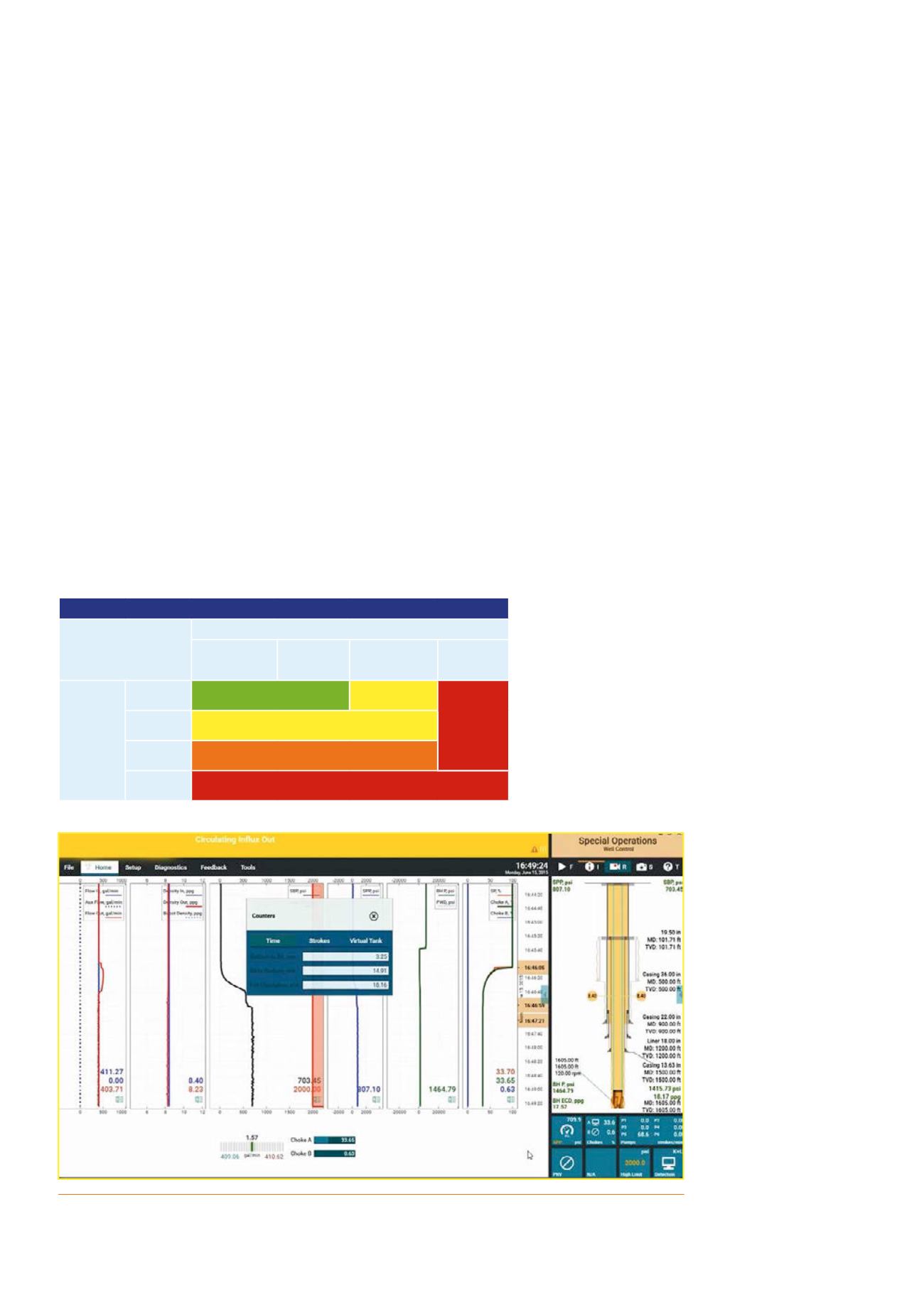
Figure 1.
OneSync software automatically detects influx and significantly reduces the risk profile.
Table 1. Surface pressure and influx indicators.
Surface pressure indicators
Max planned
drilling operating
pressure
Max planned
connection
back pressure
>Planned back
pressure
<Pressure limit
>Back
pressure limit
Influx
indicator
No influx
Normal operating window
Dynamic influx
control
Conventional
well control
Operating
limit
Dynamic influx control
<Planned
limit
Dynamic influx control
>Planned
limit
Conventional well control


