May
2016
Oilfield Technology
|
71
horizontal wellbores. In deepwater, the challenges are evenmore
complex with higher pressures, higher temperatures, and narrow drilling
margins being the norm, which increases wellbore-related NPT.
Most NPT during well construction results fromwellbore
stability–related factors such as tight holes, lost circulation, cementing
failures, and inaccurate well-control response. Each of these areas can be
mitigated by lessening reliance on human factors. Increasing downhole
visibility to enable early kick detection and automating kick response
creates the possibility of proactivemanagement of bottomhole pressure
(BHP) – amethodology that will be discussed at length in the next
section.
Newsolutions
To circumvent the gaps in conventional well control, drilling engineers
have developed several alternative solutions. One of themajor problems
presented by a subsea BOP is the seemingly inevitable presence of gas
in the riser caused by the gas entrained in oil basedmud. To combat this
issue, a simple and logical solution was developed in the formof the
riser gas handling (RGH) system. An RGH systemuses a combination of
an annular isolation device, a flow spool, and surface equipment such
as a choke to enable drillers to close the annulus above the BOP and
choke the flow to keep gas entrained in fluid until it reaches themud-gas
separator. In terms of preventing gas from reaching the surface in an
uncontrolledmanner, an RGH system is very effective. However, similar
to the addition of more rams to a BOP, it is merely another set of ‘brakes’
and does not represent a true step change in the overall well control
methodology.
Like a conventional system, an RGH system is open to
atmosphere and must be manually shut upon detecting a kick,
making it inherently reactive. The first sign of a shift toward a
new, more proactive paradigm came a few years later with the
introduction of the rotating control device (RCD) – which was already
a proven technology used on more than 50% of land wells drilled
in North America – to deepwater applications. An RCD is similar to
a BOP and RGH in that it serves as a barrier. However, rather than
leaving the annulus open to atmosphere unless manually shut, an
RCD permanently closes the path upward from the RGH to the surface
and redirects the path of flow returns. Instead of stopping the gas
and, simultaneously, halting operations, the RCD eliminates the need
for a driller to manually engage the rig diverter or RGH and enables
gas-entrained mud to flow away from the rig floor into a mud-gas
separator, where it can be processed safely.
In addition to eliminating the issue of riser gas, an RCD placed below
the tension ring introduces a new element into the well control
equation. The RCD creates a closed-loop pressurisable system that
facilitates more accuratemeasurement of pressure-flow data and
therefore increases visibility. With this information, and based on
mass balance, the driller or system is able to identify kicks, losses,
ballooning, and breathing. Manipulation of the surface chokes
further enables the driller to dynamically identify actual, rather than
predicted, pressure and fracture gradient and thereby optimisemud
weight to stay within the actual drilling window.
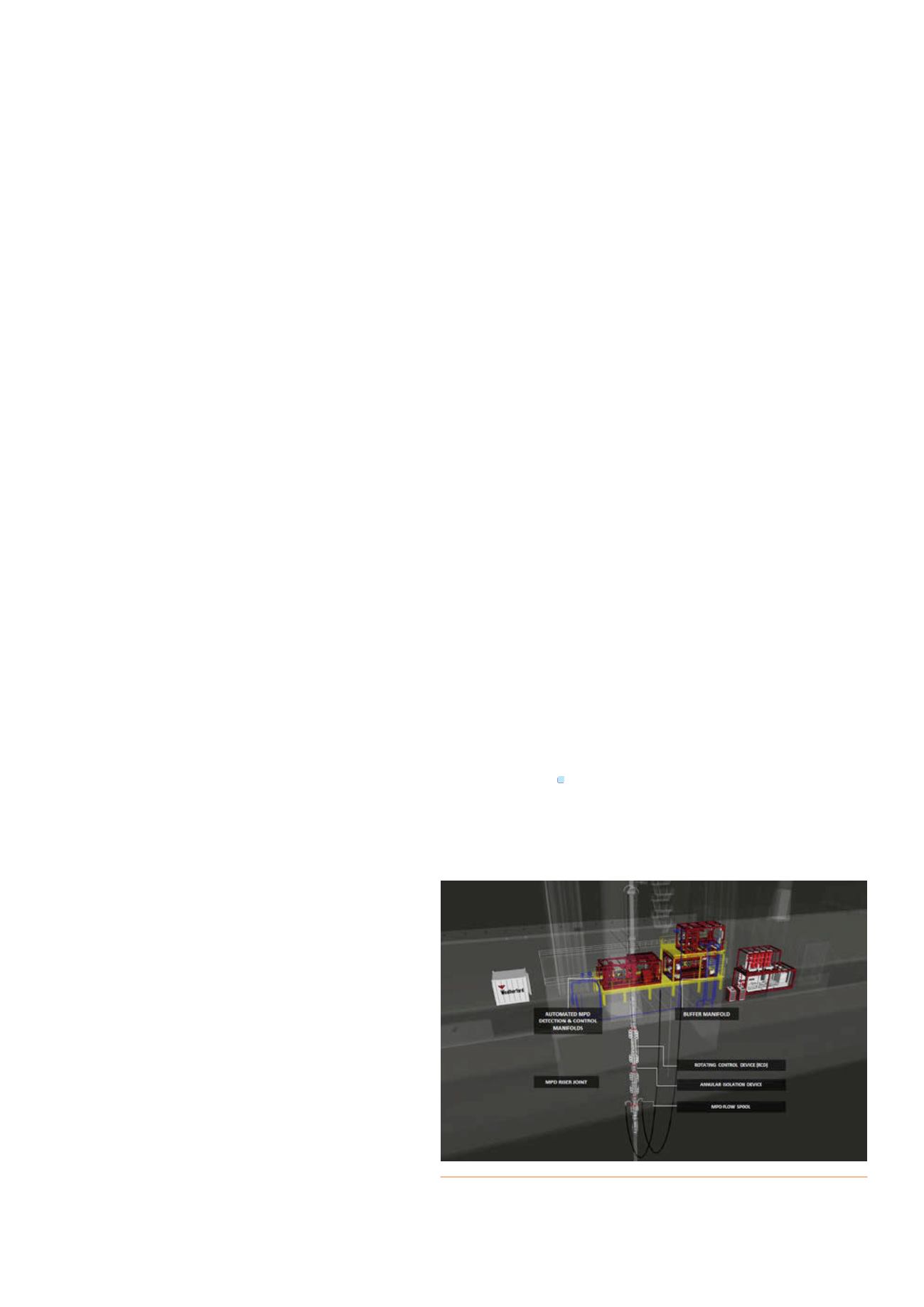
The new regime that incorporates an RCD is truly a step change.
It enables dynamic well control to be applied proactively throughout
the drilling process, and automatically and immediately responds
to an influx at source. This means that the influx can beminimised,
controlled, and circulated out at full drilling rates without having
to shut in the BOP, so drilling can resume without causing wellbore
damage.
The impact of the RCD is measurable and documented.
According to a 2010 paper authored by researchers at the University
of Texas at Austin, there is “consistent statistical evidence, across
a variety of regressionmodels and variable specifications, that the use
of RCDs decreases the incidence of blowouts.”
1
The impact is equally
significant onshore and offshore, and is demonstrably greater in
deepwater applications.
Regulatory bodies including NORSOK have recognised the significant
difference between the level of riskmitigation provided by an RCD
versus a conventional BOP or a RGH, and applied appropriately different
qualifications. Operators and drilling contractors looking to integrate
an RCD and related surface equipment into their rig should bemindful
of the change in systems certification that may be required tomeet
regulations.
Thenext step
The introductions of the RGH systemand the RCDwere both important
steps toward a better way of thinking about well control. However,
current practice still involves components that rely on human reaction
followed by amanual response. On deepwater rigs, where the risks
and costs of failure are both dangerously high, this is simply not good
enough.
A comprehensive, automated control systemwould exponentially
enhance the potential of existing technologies such as the RCD by
enabling instantaneous, data-driven action. The addition of automated
control software leverages the existing logic and introduces algorithms
that translate the flow in/out delta into commands that throttle the
choke the necessary amount to bring the system into balance. The result
is a truly automated well control system.
Any time the human factor is removed froman operation, the risk
profile is reduced by ameasurable amount. Automation therefore
represents a significant improvement over conventional well control.
If the addition of an RCD alone significantly decreases the incidents
of blowouts, per the study cited above, further automation will surely
improve safety by an order of magnitude.
The industry is once again at a crossroads. Following 2010, the
health, safety, and financial risks associated with conventional well
control were not fully addressed. Today, the industry should follow a new
avenue that leads to risk and cost reduction in the formof automated
well control. The technology exists, the results are supported by data,
and significant benefits are within grasp. The industry as wholemust
take the leap.
References
1.
Jablonowski, C.J. and Podio, A.L., ‘The impact of Rotating Control Devices on the
incidence of Blowouts: A Case Study for Onshore Texas, USA’, Society of Petroleum
Engineers, (2010).
Figure 2.
A newwell control regime that incorporates anRCD represents a true
step change.


