64 |
Oilfield Technology
May
2016
Ì
Ì
Daily – well and reservoir surveillance and optimisation, daily loss
management.
Ì
Ì
Weekly – well information package (sets operating plans for upcoming
week).
Ì
Ì
Monthly – short-termproduction and tanker lifting forecasts (as
appropriate), reservoir simulation, production allocation.
Ì
Ì
Quarterly – financial forecasts, opportunity and risk registers.
Ì
Ì
Annual – reserves reporting, well by well reviews, strategic plan,
operating plan, gas nominations, consents, stewardship reporting,
TEF reporting, CoP reporting.
Ì
Ì
Adhoc – well-testing, well integrity testing, well and systemmodelling
and adhoc reservoir simulation requests.
This thorough approach and close co-operationmade it possible
to take responsibility for reporting andmanagement of the assets in
conjunctionwith the operator’s staff in the earlyweeks of the transition,
leading to eventual transfer of all operational activities to LR Senergy
within four weeks of the process commencing.
Meetingsmanagement
Full inventory of daily, weekly, monthly quarterly and annual meetings
was discussed and scheduled complete with appropriate terms of
reference. Thesemeetings included both internal and external meetings
(e.g. with joint venture partners, regulatory bodies etc). This discussion
was very fruitful in that it rationalised and reduced both the number and,
in some instances, the frequency of meetings.
Qualitycontrol/peer review/projectmanagement
This scope of work included the completion and agreement of the
transition plan in addition to the ongoing peer reviewand quality control
of the service being delivered by the pre-CoP team.
The transition stagewas successfully completed in the time frame
specified at the beginning of the project. Consequently, after fourmonths
of the operator and LR Senergy teamsworking together, the full technical
and operational management of the two fieldswere being run by an
outsourced pre-CoP team fromthe company’s office in Aberdeen.
Thismodel is helping the operator to reduce costs and, by assigning
the right resources, progress is beingmade towards ensuringmaximum
longevity of the fields; delaying abandonment as long as possiblewithin
the constraints of optimisedwell and reservoir performance.
The company’s services have provided a different viewand
recommendations in a number of areas for the operator such as:
Ì
Ì
Managing the reservoir and subsea pipeline network using a different
approach following a close look at the efficacy of water injection and
‘back-out’ in the subsea pipeline network.
Ì
Ì
Achieving the first good quality history match on one of the fields by
integrating all of the available data including themost recent seismic,
well-test and inter-well connectivity data but, most critically, the
matching of seawater composition.
Ì
Ì
Using the above-matchedmodel to enable an informed decision to
bemade recommending that a proposed pre-emptive scale inhibitor
formation squeeze should not be performed. This saved significant
cost andminimised deferred production.
Ì
Ì
Providing a range of options for improving oil rate and recovery
by performing water shut-off via either thermally – or chemically –
activated polymers at either or both injector or production wells.
Both treatments were considered for deployment via the subsea
manifolds rather than by direct well intervention to reduce both cost
and risk.
Ì
Ì
Providing a cement assurance assessment and technical
recommendation for abandoning an interval above the main
reservoir to ensure a safe and cost-effective well abandonment can
be performed for the entire wellbore. This assessment was part of
a more complete well abandonment service that exists within the
company.
Subsequent to the above achievements and ongoing field
optimisation, it has been recognised that the level of service required
from the pre-CoP team can be reduced. This transition has recently
been successfully negotiated with the operator, further reducing
operating cost while still delivering the necessary level of specialist
services.
Outsourcing the running of assets approaching CoP is a logical
solution formany operators since it should allowboth a reduction in
costs in addition to redeploying valuable staff intomore strategic and
value-adding assets. Outsourcing to a pre-CoP teamwith specialist skills in
the delivery of this service is a bold but effective stepwhich should ensure
delivery of a smooth transition fromthe production phase to the CoP
phase.
LR Senergy has taken part in numerous late/end of field life projects
and in this instance has specifically taken on the subsurface and
productionmanagement of a field approaching CoP. By having a greater
understanding of the full subsurface and productionmanagement
requirements in-house, aswell as other integrated services includingwells
and facilitiesmanagement, the company has access to all the required
capabilities to assist in the process of managingmature fields up to and
including CoP.
There is currently a lack of guidelines fromtheUK regulator relating
towhat should be donewith data fromdecommissioned assets beyond
themandatory CoP document thatmust be presented to the government
when an asset ismoving towards CoP. This includes the full history of the
asset in addition to such data sources as rawseismic data, drilling cuttings,
cores, fluid samples etc. Collaboration between all stakeholders, including
regulatory authorities, operators and service companies, is required to
determine themost efficient way to archive field data. The newposition of
head of records and documentmanagement inOGAmay help to guide this
clear requirement.
However, with over 300 existing structureswithin theUKCS needing
to be removed safely and environmentally soundly in the not too distant
future, the need for a smooth transition fromthe production phase to
the CoP phase is becoming an ever pressing issue. The cost-effective
deployment of specialist ‘end of field life’ services in combinationwith
clear regulation should allow theUKCS to become aworld leader in this
area inwhich LR Senergy is keen to play its part.
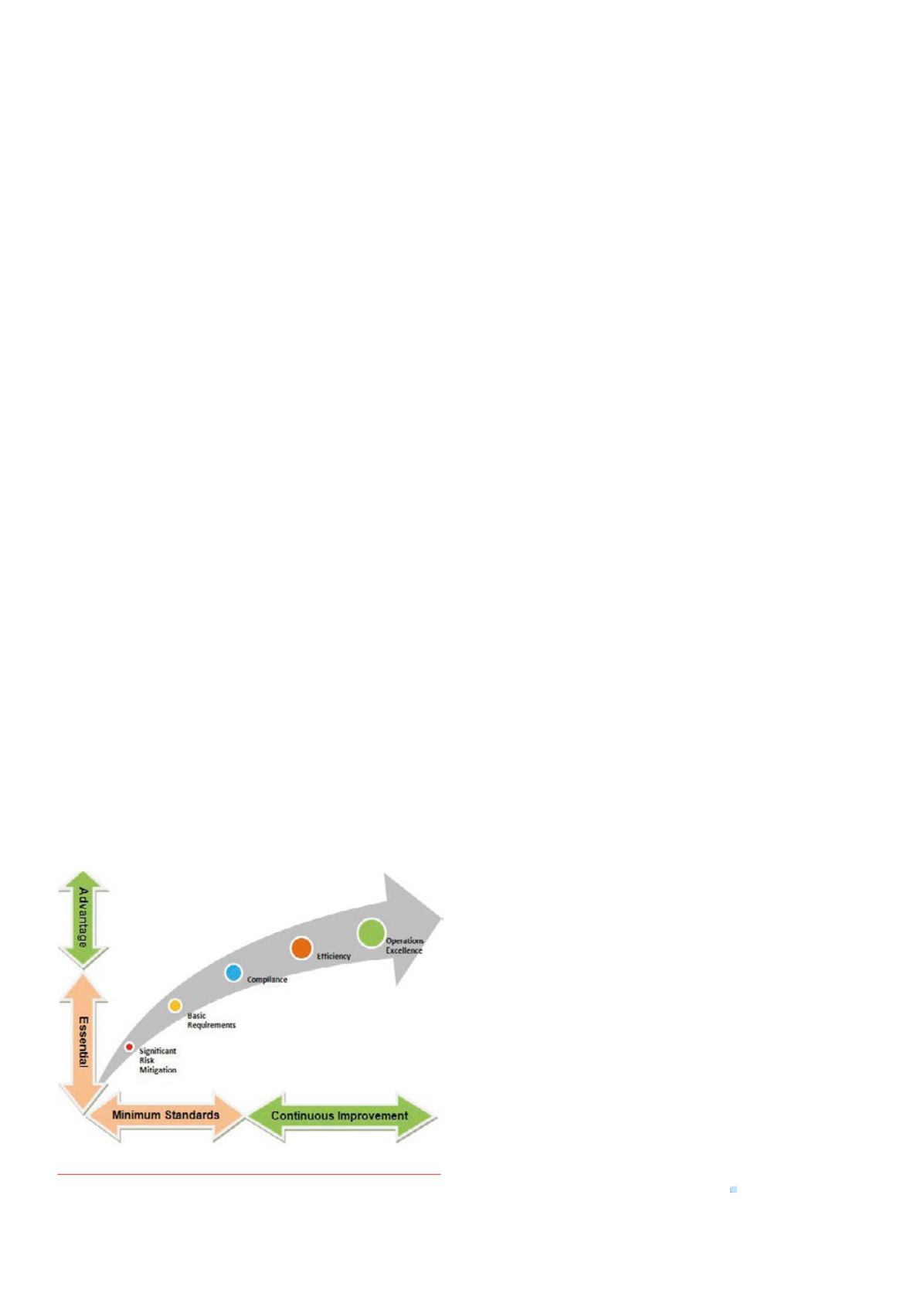
Figure 1.
The journey to operations excellence.


