58 |
Oilfield Technology
May 2016
lw d/mwd Q&A
and conductivity. To put it bluntly: operators often had no
idea when the EM signal would no longer reach surface,
necessitating a trip to replace them with mud pulse. For
this reason, many operators played it safe and only used
EM in extremely shallow wells where signal transmission
was guaranteed.
The second issue was the extremely high power
consumption of the systems with batteries lasting tens
of rather than hundreds of hours, again requiring more
trips to replace batteries or running hugely expensive high
power lithium battery packs.
A number of suppliers have recently introduced twin
or simultaneous EM mud pulse systems onto the market
that help solve the operating window problem. By having
a system that has both mud pulse and EM the operator can
reap the benefits of both systems, drilling ahead quickly
when EM signal is strong and switching over to mud pulse
when the conditions dictate. This redundancy reduces
lost time and means that the EM can be really pushed to
the limits of its depth window without risk. Many users
are finding that the depth limits of EM are far deeper than
expected.
The most advanced of the new systems have also
solved the power consumption challenges and are on a par
with mud pulse power usage (>100s of operating hours).
The use of true AC wave transmission using ultra low noise
transmitters means power consumption has been slashed
without detriment to signal strength. This low power usage
means that some systems can run mud pulse and EM at the
same time, which gets rid of any down time that may occur
when changing transmission systems.
Mudpulsetelemetry
Mud pulse remains the cornerstone of most operators
inventory with its flexibility and reliability ensuring its
usage on a majority of operations. The drilling community
is very conservative and often focuses on what works
rather than what may work better. Improvements in
technology are often small and incremental and the
changes in mud pulse technology over the last few years
are evolutionary rather than revolutionary.
Bit rate and power consumption are the key issues the
engineers have strived to improve on the back of demands
from the field.
Most modern positive pulsers have moved over to
highly efficient DC motor driven designs, which use almost
half the power of the older solenoid based systems. DC
motors are also highly controllable and allow the user
to operate at the smallest possible pulse width whilst
maintaining good signal characteristics. This allows the
system to run at maximum quoted bit rates in a tougher
array of conditions.
A number of companies are also working on advanced
surface filtering to remove noise such as that generated by
the mud pumps, which could mask the shorter pulse width
signals.
The gains for these efforts are still only fractions of a
bit per second but at 1 bit per second (think semaphore)
that is a significant percentage increase. It really
helps the operator who has to make tough choices
about what is sent up hole. The increased demand
for more data from new sensors such as resistivity,
annular pressure and drilling dynamics has only
made things harder.
Another technique to help eke out the bit rate
has been the adoption of dynamic sequencing,
which takes external sensor inputs from the
drilling process to decide which information
needs to be transmitted. Sensors allow the
processor to understand what is happening at
that moment in time (sliding or stationary, mud
pumps on or off) to capture and transmit the right
data. The downhole processor is predicted to get
even smarter in the future. An example would be
the jump to an emergency shock sequence when
damaging drilling dynamics are detected.
The same downhole processor is also actively
involved in battery management allowing the
system to manage and select multiple batteries in
parallel. This gives the system redundancy whilst
maximising the life of the highly expensive lithium
cells.
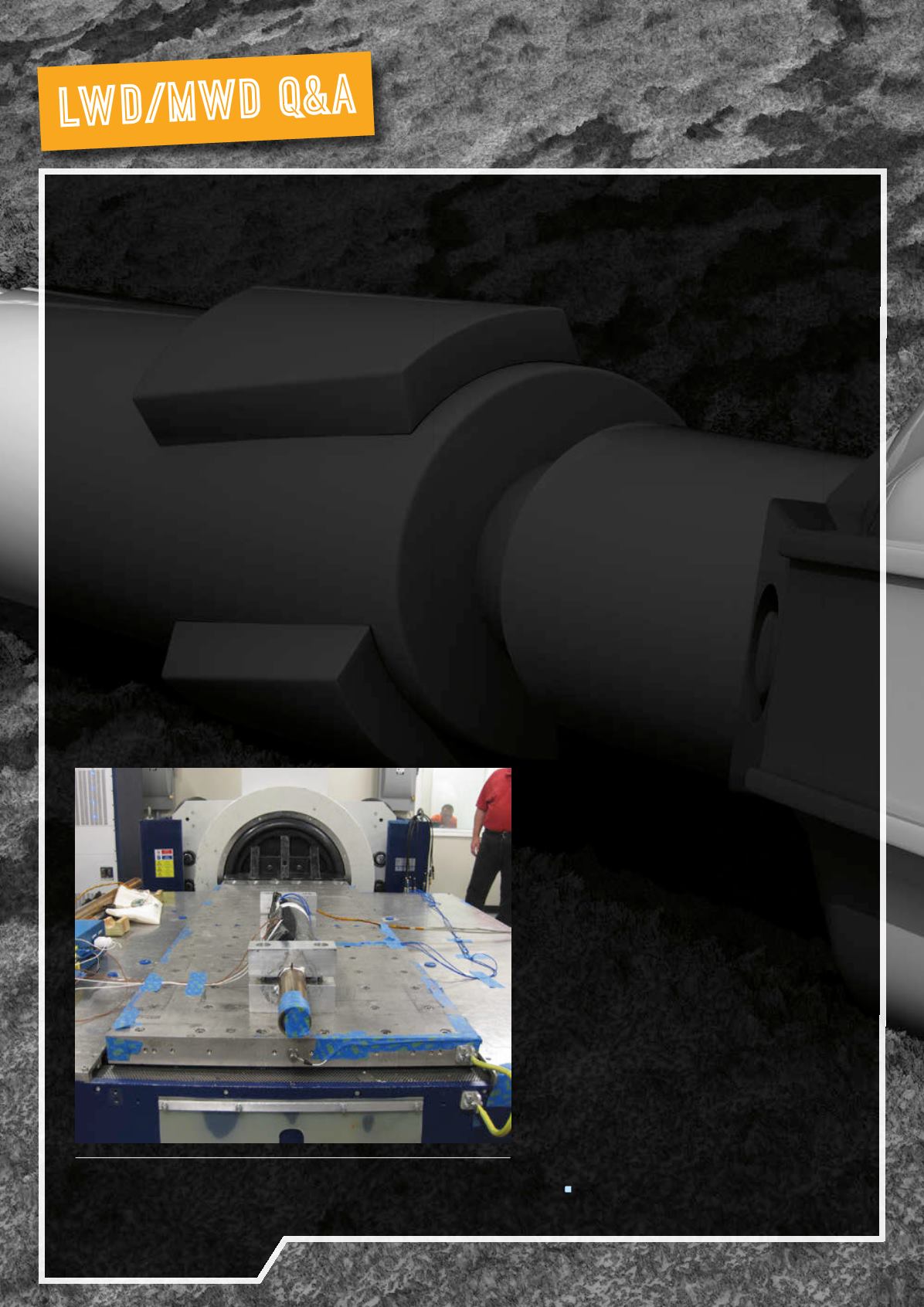
Figure 3.
Modelling the response of sensors to shock and vibration onan
environmental test.


