54 |
Oilfield Technology
May 2016
lw d/mwd Q&A
TimParker,Paul Cooperand
Wael elDeftar,Halliburton.
Directional drilling
The age of easy drilling is definitively over. Wells are getting
deeper and longer, while reservoirs are getting tighter and more
complex than before. Drilling campaigns can easily fail to deliver
prospected results when uncertainty and risk are overlooked. In
general terms, an oil well is drilled to satisfy certain geological
or subsurface objectives in terms of well placement within a
reservoir or gathering formation evaluation data. It is clear that
drilling operations must be designed and executed to deliver
such objectives in the safest and most economical way. Drilling
Engineering Solutions (DES) is a sub-unit of Sperry Drilling that
has developed a complete drilling management approach that
helps to identify, early in the planning process, potential risks
in the well’s lifecycle. These risks can then be managed during
the design phase, defining key success factors to be carefully
monitored during the execution of the well. The developed
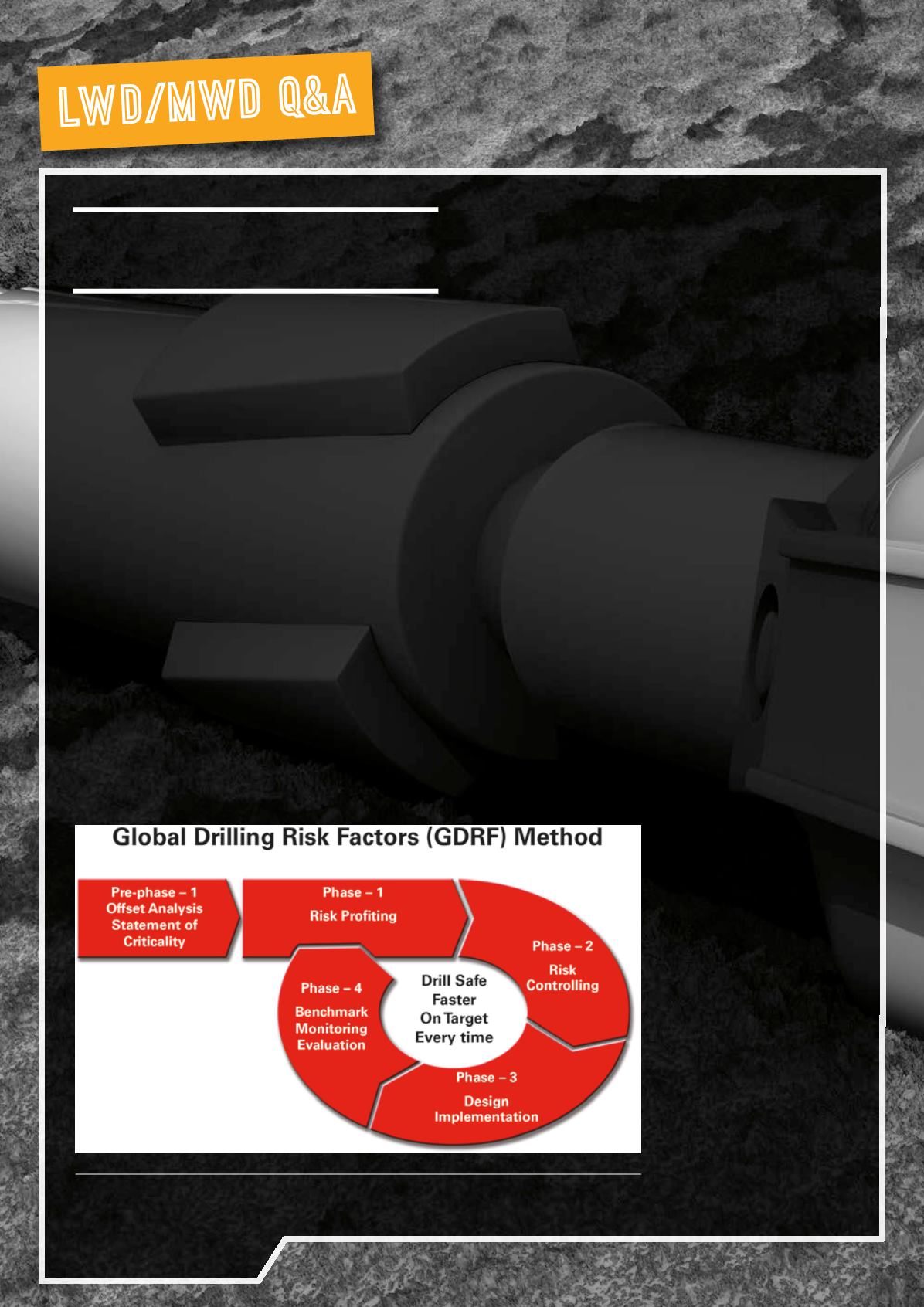
approach is based on a risk-management process called the
Global Drilling Risk Factors (GDRF) method.
GDRF was developed to overcome misconceptions and design
inefficiencies by introducing a systematic approach to assist in
the effective management of drilling campaign risks. It guides
the project team to go into greater detail to map drilling risks,
helping reduce the dependency on individual experience levels.
The method addresses potential risks that could otherwise be
neglected by drilling departments, such as the effect of formation
evaluation requirements on bottomhole assembly (BHA)
behaviour and performance. Many logging-while-drilling (LWD)
tools include stabilisation points and different sizes, and their
position in the BHA, which is mainly determined by geological
requirements, can greatly affect BHA dynamics in terms of
vibration, which is one of the greatest risks faced in today’s drilling
operations. Such risks, when neglected, can easily lead to cost
overuns. By the end of 2014, since its initial implementation on
critical and challenging drilling campaigns, the GDRF method had
produced successful results, satisfying the various subsurface
requirements.
HPHTconditions
The industry continues to expand its exploration and development
into more technically challenging areas. A prime example of
such a challenge is drilling and evaluating reservoirs with higher
and higher in-situ temperatures. Until recently, operators had
little choice but to drill such reservoirs ‘blind’, with no real time
downhole measurements to guide them.
In 2013, Sperry Drilling introduced an M/LWD system capable
of operating at up to 200˚C (392˚F). The Quasar Pulse
SM
service
features an integrated, real time system, providing a set of
essential downhole measurements that helps improve the safety
and efficiency of drilling a well. The system sheds new light on the
challenge of drilling in high-temperature environments, providing
the operator with far greater control over the well, based on some
key pieces of real time information:
Ì
Directional surveys for better control of well placement.
Ì
PWD measurements for more accurate control of downhole
ECD, helping reduce the risk of well control incidents in wells
that typically have a narrow pressure window in which to
operate safely.
Ì
Drillstring dynamics measurements that provide feedback
on BHA performance, helping to
maximise drilling efficiency and
prolong BHA life.
Ì
Natural gamma-ray
measurements that give the
geologist key information
with which to correlate the
well position against the
earth model.
In 2015, Sperry Drilling drilled
a well in the Gulf of Thailand using
the world’s first triple combo suite
of LWD tools capable of operating
at 200˚C. The string incorporated
the Quasar Pulse system, with
additional resistivity, neutron
porosity and azimuthal density
sensors, operating for a total of
155 hours over two runs, drilling
over 6000 ft (1829 m) and reaching
a maximum temperature of 197˚C
Figure 1.
DES implements GDRF tomitigate risks suchas vibrations to helpdrill more efficiently.


