48 |
Oilfield Technology
May
2016
cost equation, in addition to the original material (centraliser)
costs.
Cost-benefitequationfor centralisers
In a traditional standoff-based view of centraliser products, it
makes sense to consider the cost of the tubular consumable
product prominently in the selection process, particularly if
multiple product options are available that can reliably meet
the application need. However, this strategy can quickly break
down if an application demands increased functionality from the
product, or if a failure leads to unplanned costs that far exceed
the material cost savings available.
For centralisers in extended reach wells, industry is
venturing into a new area. There is an increasing need for
centraliser products that will reliably enable operators to install
their casing and liner strings farther than ever, and at the same
time have the ability to withstand harsher running conditions.
The cost-benefit equation of equipment and service options that
enable successful casing and liner runs needs to be revisited
with a perspective that clearly includes the factors that have
changed. This requires vision, and having to quantify and
work through uncertainties and challenges along the way
is to be expected.
Volant’s perspective is that there are four fundamental
factors that must be considered as centralisers are
selected and configured:
Product functional requirements
It is important to identify what is expected from the
product in service, and to use the right centraliser for the
right application (and at the right points in the well).
Product installationrobustness
Centralisers must withstand the rigours of installation
and must be intact once TD is reached to provide required
standoff.
Local frictionmanagement
As the centralisers will generally be a primary contact point
between the casing string and formation, friction between
the centraliser and the borehole contributes to running
resistance.
Global frictionmanagement
The factors that govern whether a string will reach TD
smoothly are complex, and go beyond the cumulative
effect of local friction at each contact point. This is the area
that currently poses the largest challenge and the largest
opportunity for advancement.
By considering each of these factors, the industry can
more readily identify components that must be treated
with care, as the frontiers of ERD casing running are
pushed, and pinpoint factors that offer the most cost
saving opportunity.
Product functional requirements
Centralisers are traditionally used to achieve pipe standoff
from the borehole wall, and also have some performance
requirements that should be considered in the selection
process:
Ì
Standoff is the most obvious parameter, and a range
of product solutions (bow spring, rigid, semi-rigid) is
available. Standoff should be considered in the in-situ
loading condition, which demands estimates of the
amount of side force being applied to the centraliser,
centraliser lateral compliance, and pipe sag between
centralisers.
Ì
Coverage, contact area, and rib shape are parameters that
are associated with the design of the centraliser and how
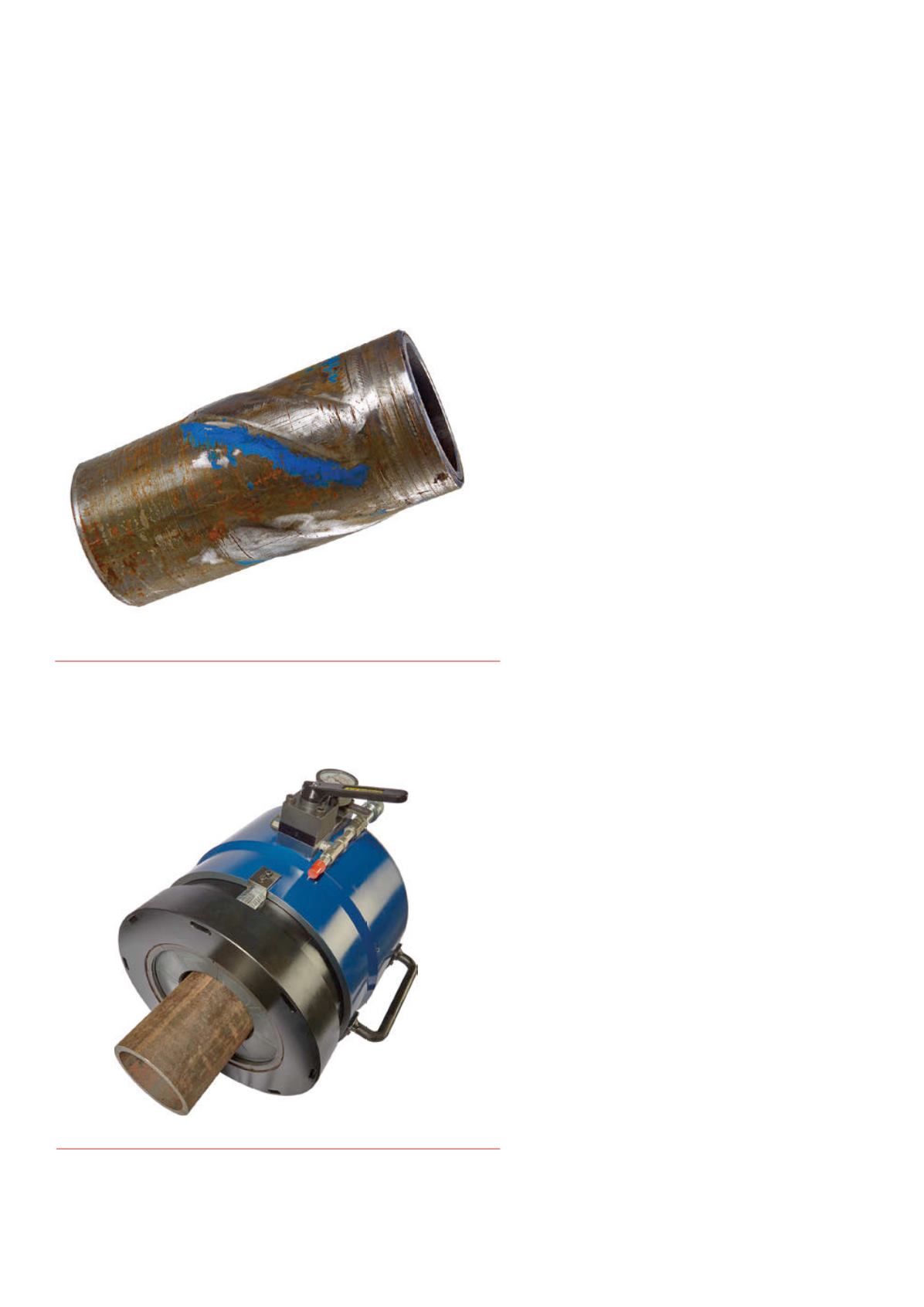
Figure 3.
HydroFORMcentraliser used inan extreme liner drillingapplication that
requiredmultiple trips. In this crimp-onapplication, the string hadanaccumulated
runningdistance of 65 870 ftand over 41 000 revolutions, with the entire lot of
installed centralisers remaining intact. Wear on the centraliser ribsmeasured less
than¼ in. onOD, or less than half of the original wall thickness.
Figure 4.
Volant’s radial tubular forming (RTF) tool used for crimping centralisers,
stop collars andwear bands to casingand liner strings.


