Ì
Shock testing simulates the effects of wear and tear
on components and assemblies. Demonstrating
the potential life of products under such conditions
actively identifies areas for design improvement to
maximise longevity of a project.
In addition, the facility has the knowledge, experience
and capabilities to improve environmental performance
of specific materials by surface effects and coatings.
For example, heat treatment through use of a specialist
hydrogen furnace can make materials harder, softer,
more flexible or more resistant, and the potential when
considering specialist surface coatings is manifold.
Case study: metal coating by sputtering
Formerly used primarily to produce integrated-circuit
components, metal coating by sputtering has moved
on to large, production-line jobs such as coating of
automotive trim parts. The metal coating sputtering
process deposits thin, adherent films in a plasma
environment on virtually any substrate, which can
be a useful process to consider when conducting
environmental testing.
Metal coating by sputtering offers several advantages
to automotive manufacturers for an economical
replacement for conventional chrome plating. Sputtering
lines are less expensive to set up and operate than plating
systems. And because sputtered metal coatings are
uniform as well as thin, less coating material is required
to produce an acceptable finish. Pollution controls are
unnecessary because the process does not produce
any effluents and the process requires less energy than
conventional plating systems. Metal coating by sputtering
is the only deposition method that does not
depend on melting points and vapour pressures of
refractory compounds such as carbides, nitrides,
silicide, and borides. As a result, films of these
materials can be sputtered directly onto surfaces
without altering substrate properties.
Much of the research in metal coating by
sputtering is aimed at producing solid-film
lubricants and hard, wear-resistant compounds.
There is interest in these applications because
metal coatings can be sputter-deposited
without a binder, with strong adherence,
and with controlled thickness on curved
and complex-shaped surfaces such as gears
and bearing retainers, races, and balls. Also,
because metal coating by sputtering is not
limited by thermodynamic criteria, unlike most
conventional processes that involve heat input,
film properties can be tailored in ways not
available with other deposition methods.
Research on sputtered solid-lubricant metal
coating has been done mainly with molybdenum
disulphide (MoS
2
). Other metal coating that has
been done with sputtering includes tungsten
carbide, titanium nitride, lead oxide, gold, silver,
tin, lead, indium, cadmium, PTFE, and polyimide.
Of these coatings, gold-coloured titanium nitride
coatings are most prominent. Tin coatings are
changing both the appearance and performance
of high-speed-steel metal cutting tools, and can
increase a product’s life by as much as tenfold.
Conclusion
The use of coating technologies is an active
approach to safeguard against environmental
damage and is a useful consideration when
undergoing environmental testing in the design
phase of a product’s life.
Figure 3.
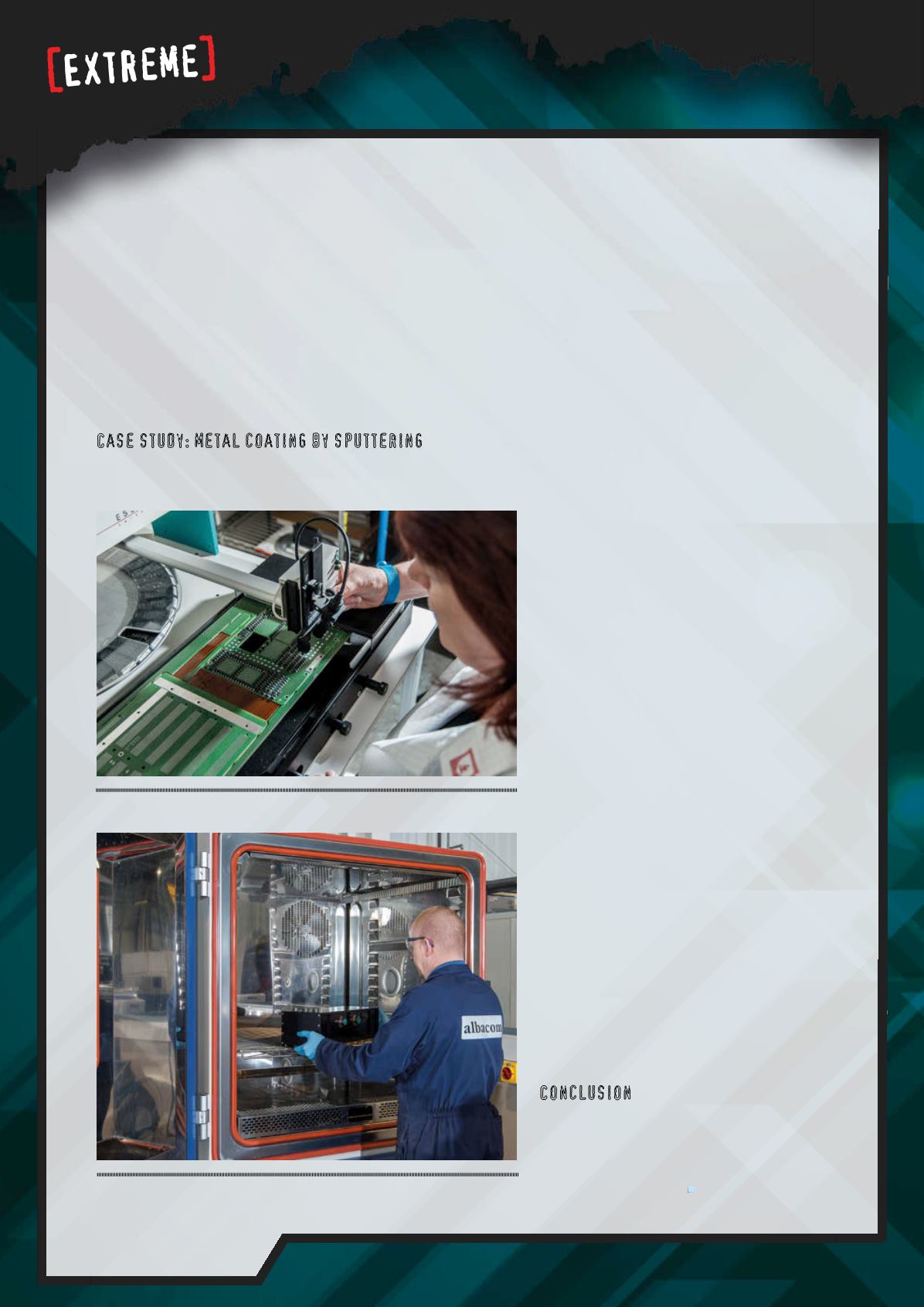
Thermal cycling test usingan Albacomenvironmental test chamber.
38
|
Oilfield Technology
May
2016
Figure 2.
Placing of surfacemount components onan electronic backplane.


