May 2016
Oilfield Technology |
33
samples or evidence not captured in the sample bottle will go
undetected. By contrast, on-line sensor technology can deliver a
continuous streamof a few key condition parameters to the operator,
without the need to physically access the equipment for inspection.
This allows a representative assessment of the condition of the asset
at any givenmoment and for corrective action to be appropriately
scheduled, long before significant damage occurs. By combining all
threemethods for critical equipment, operators are best armed to
maximise efficiency whilst minimising cost and risk.
Combining new on-line sensor technologies with existing
techniques is easier than it may first seem. Often, they can be
easily integrated into existing conditionmonitoring and operating
control systems, withminimal impact on cost and time required
for installation. Normally, with both digital and analogue outputs,
sensors provide instant data where it is most needed.
As an example, traditionally, thruster service intervals are
based upon the number of hours of operation and generally
assume the thrusters are running at 100% load, 100%of the time.
Monitoring betweenmaintenance tasks is carried out by periodically
taking small lubricant samples and sending them to shore for
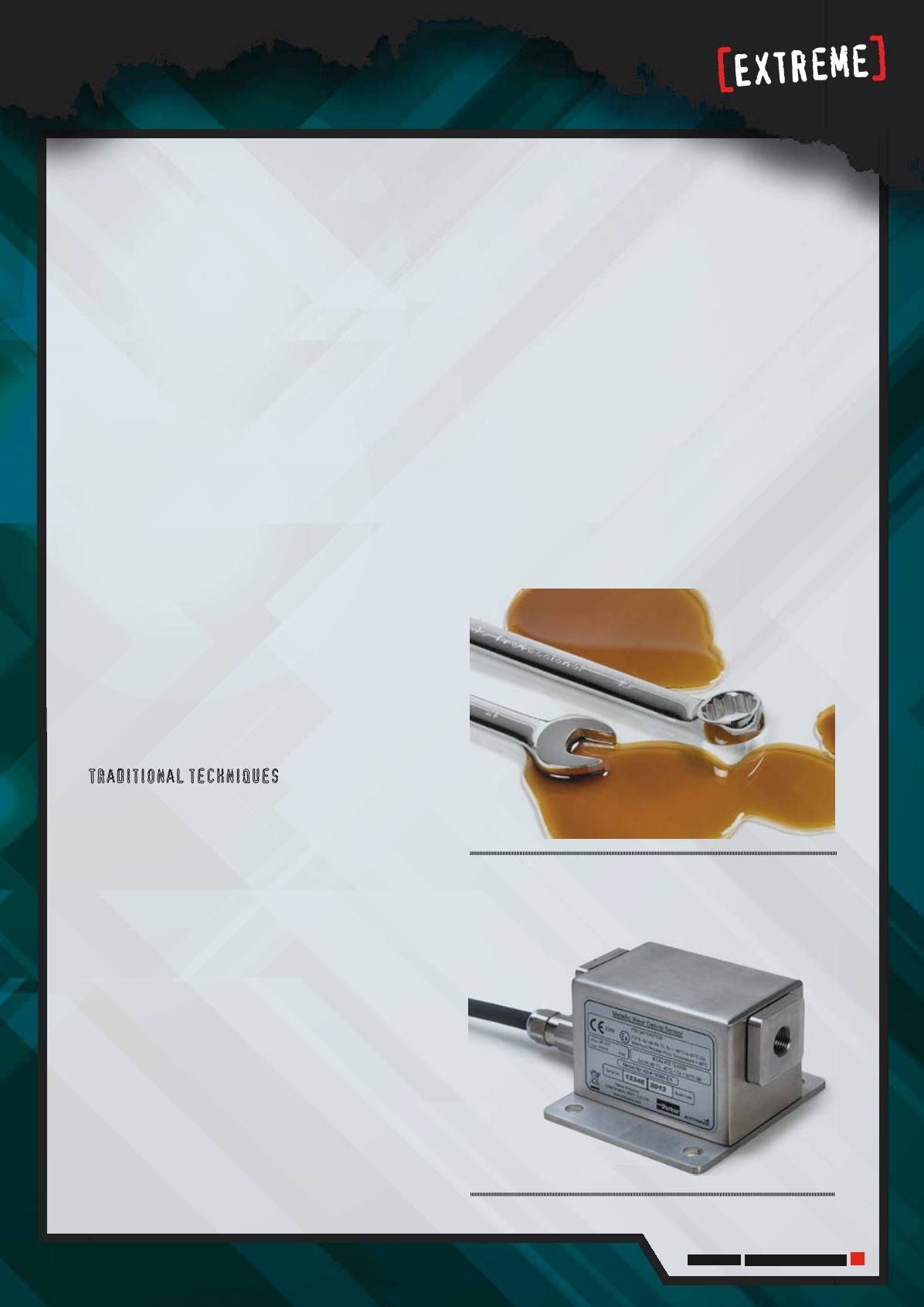
Figure 1.
Lubricating oil is essential to protecting the operational
lifespan of equipment andmachinery.
Figure 2.
Parker Kittiwake ATEXmetallicwear debris sensor.
Many companies are already employing a reliability-centred
maintenance strategy; optimising theirmaintenance based upon the
actual condition of equipment, rather than the arbitrary operating
hours. It stands to reason that themore accurately the condition is
known, themore effectivelymaintenance can be scheduled. Yet,
despite conditionmonitoring technology advancing significantly
over recent years, many companies are still employing exactly
the same techniques as a decade ago. For example, newwear
debris sensors can copewith the extreme conditions andmeet
the hazardous zone requirements of being installed directly on a
top drive. Local installation provides real timemonitoring of the
gearbox lubricant, and the fastest, most representativemachinery
condition data. Despite this, many companies still choose to rely
upon periodically taking small samples of oil, sending themto
shore-based laboratories and thenwaiting for the results to be
returned.
As the lifeblood of many valuable assets, lubricating oil is
essential to protecting the operational lifespan of equipment and
machinery. Essential assets, such as thrusters or top drives, are
critical for the safe and efficient operation of offshore vessels and
their associated profitability. The consequences of failure, both in
terms of lost revenue fromunscheduled downtime and the cost
of repair or replacement, are severe. Even if a replacement unit
is available locally and at short notice, the costs resulting froma
catastrophic failure can easily run into themillions of dollars. It is
therefore critical that these key pieces of equipment aremonitored
continuously and proactively, in order to identify potential issues
and to be able to schedule appropriate, corrective action. The sooner
an issue is identified, themore likely therewill be options available
to rectify it, often at the lowest possible cost.
Traditional techniques
When operating in extreme environments gaining access to assets,
both to determine their condition and to performpreventative
maintenance tasks, can be complex and hazardous. It can often
put the operator at increased risk of injury, whilst also generally
necessitating the equipment being taken off-line, costing time
andmoney. An additional and often overlooked consideration
is that inspection can introduce contamination fromoutside the
equipment. This, alongwith the potential for human error, can
cause damage to the equipment and lead to subsequent failure.
Once again, the techniques used to gather the required condition
information are frequently found to be centred on one or two
traditional techniques, despitemodern advances.
There are distinct advantages to using the various forms of
conditionmonitoring techniques, both traditional andmodern,
in combinations dependent upon the equipment criticality.
Laboratory analysis of in-service lubricants can provide a very
detailed assessment of the condition of the oil, identifying
problems that can be impossible to detect in other ways.
On-board testing of lubricants, using simple, rugged equipment
can identify common problems immediately, without incurring
the unavoidable delay associated with laboratory analysis.
However, both of thesemethods rely upon periodically taking a
representative sample of the oil. Problems occurring between


