24 |
Oilfield Technology
May
2016
possible to know what the rock type and properties are at depths
kilometres below the sea or land? The modern paradigm is to use
seismic data in its many guises combined with an understanding
of rock physics.
In practice there are two ways to approach the problem:
Ì
Ì
In seismic forward modelling, understanding the facies
distribution is crucial, as then per-facies rock physics models
can be used to transform rock properties (e.g. porosity,
Vshale, saturation) to elastic quantities (impedances),
from which seismic can be synthesised using a variety of
techniques and iteratively compared with actual data.
Ì
Ì
The flipside of forward modelling is inversion. It is
interesting to note that in model-based seismic inversion
to date facies are not used as a key quantity; they are often
only derived from the inverted impedances in a secondary
step.
This asymmetry is unhelpful, and compromises the seismic
inversion results. This article will demonstrate that incorporating
facies within the seismic inversion algorithm can give superior
results.
Seismic forward modelling is, by definition, the inverse of
seismic inversion, and vice versa. Nevertheless, they serve the
same purpose: to try to understand what the seismic signal
means. The two processes are actually quite similar; the term
‘seismic inversion’ suggests an operation from seismic to
impedances and/or rock properties in one step, but in practice a
model is repeatedly updated and forward modelled to synthetic
seismic in an optimisation loop, until it adequately fits the actual
seismic.
Although in forward modelling a model of impedances can
be created and synthesised with the corresponding seismic, in
practice it is typical to start with a model of facies (the critical
component) and rock properties, and then use per-facies rock
physics models to derive impedances, after which the synthetic
seismic can be determined.
In model-based seismic inversion methods (and other
techniques, such as full waveform inversion) forward modelling
also takes place repeatedly (in an optimisation loop, as
explained), but here facies are not used. How can facies be a key
quantity in ‘normal’ forward modelling, but be unimportant in
forward modelling as part of seismic inversion? This article will
explain that incorporating facies within the seismic inversion
process will lead to a better seismic interpretation, and will
substantiate that with a case study.
Elasto-faciesassociations
Before explaining how facies can be used within seismic
inversion, it would be useful to clarify the term ‘facies’, which
is really a geological term. In this geophysical article, the
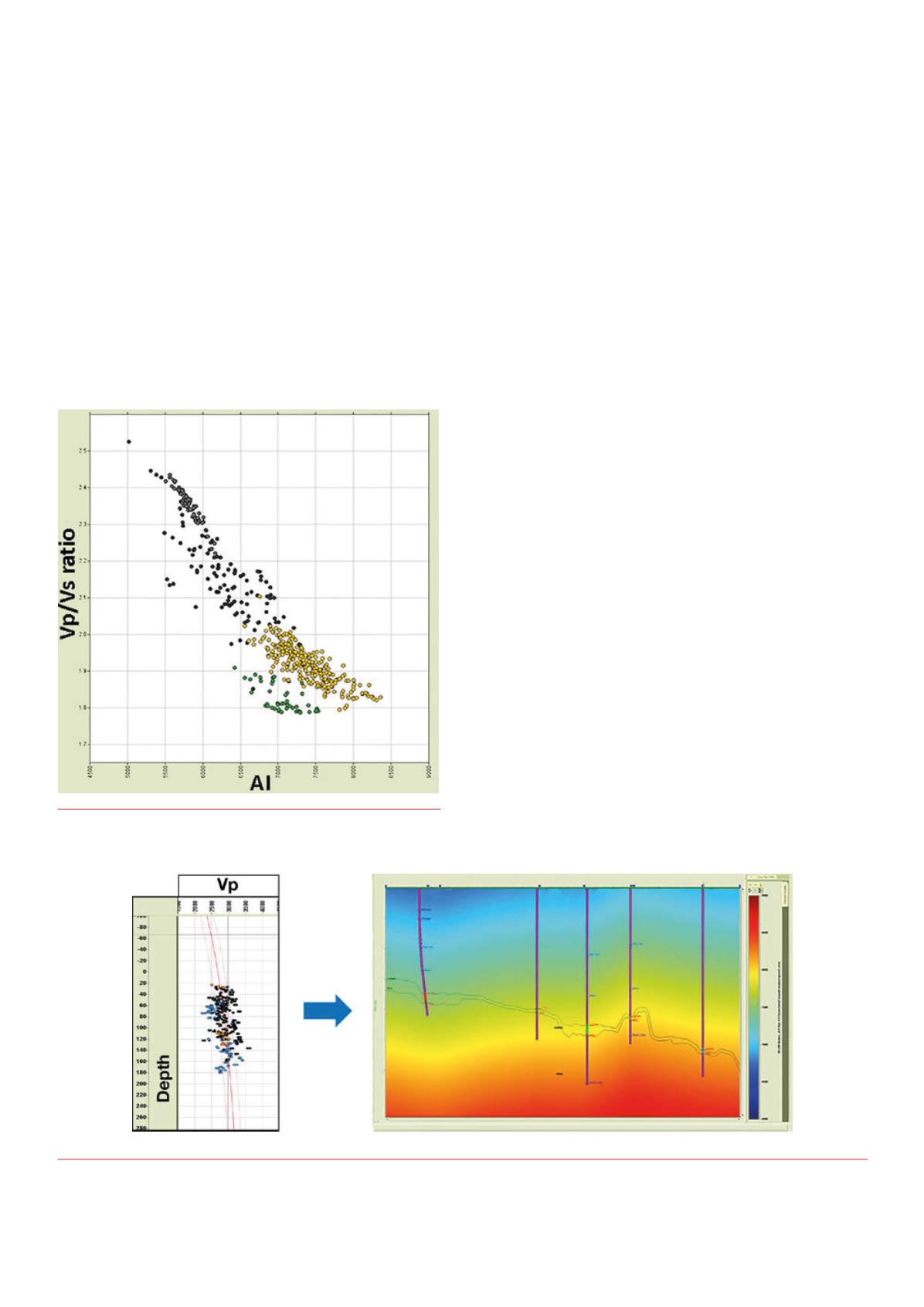
term means elastically distinct rock-types (Figure 1) with
resolvable layer thicknesses (i.e. in excess of an eighth (⅛) of
the seismic wavelength ).
1
Where these criteria are not met (i.e.
elastic properties overlap and/or thicknesses are too small),
facies should be combined into what we call ‘elasto-facies
associations’. Note that after the inversion, elastic quantities
Figure 2.
Shale Vpplottedagainst depth belowseabed, with uncertainty (left) and the Shale Vp LFM; uncertainty not shown (right) .
Figure 1.
An example of three elastically distinct rock-types.


