20 |
Oilfield Technology
May
2016
and travel time errors computed from migrated gathers for every
ray pair:
of mistie or welltie tomography, migrated gathers have already been flattened; therefore,
errors along the ray path are equal to zero. Equation 1 describes the linear relation between
the model parameters along ray pairs and travel time errors computed from migrated
r every ray pair:
0 = =
!!
∆
!
+
!!
∆
!
+
!!
∆
!
+
!!
∆
!
! !!!
(1)
ndex running on all model nodes.
∆ , ∆ , ∆
∆
are variations of the axial velocity, delta
n Thomsen parameters and the horizon depth values respectively, or mistie.
!,!,!,! !
are the
components of the influence matrix (Liram et al., 2014). Mistie information is used to update
ound velocity model. Equation 2 shows the linear relation between mistie information and
d model updates:
with k an index running on all model nodes.
and reflectors’ de th) along ray pairs to travel time errors computed from residual moveouts al ng
migrated gathers, through global minimization in which a set of linear equations is solved.
In the ca e of mistie or welltie tomography, migrated gathers have already been flattened; therefore,
travel tim errors along the ray path are equal to zero. Equation 1 describes the linear relation between
changes in the model parameters along ray pairs and travel time errors computed from migrated
gathers for every ray pair:
0 = =
!!
∆
!
+
!!
∆
!
+
!!
∆
!
+
!!
∆
!
! !!!
(1)
with k an index runni g on all model nodes.
∆ , ∆ , ∆
∆
are variations of the axial velocity, delta
and epsilon Thoms n parameters and the horizon d pth values respectively, or mistie.
!,!,!,! !
are the
respective components of the influence matrix (Liram et al., 2014). Mistie information is used to update
the background velocity model. Equation 2 shows the linear relation between mistie information and
background model updates:
are
variations of the axial velocity, Delta and Epsilon Thomsen
parameters a d the horizon depth values respectively, or m stie.
d model in depth (axia
97). The goal is to associate
isotropy interval parameters,
residual mov outs along
ations is solved.
y been flattened; therefore,
es the linear relation between
mputed from migrated
!
(1)
ns of the axial velocity, delta
ly, or mistie.
!,!,!,! !
are the
information is used to update
een mistie information and
a
re the respective components of the influence matrix.
2
Mistie information is used to update the background velocity
model. Equation 2 shows the linear relation between mistie
information and background model updates:
−
!!
∆
!
! !!!
=
!!
∆
!
+
!!
∆
!
+
!!
∆
!
! !!!
(2)
ept is known as Time Preserving Tomography. The goal is for travel time computed along the
to remain unchanged following the background model update; therefore, a new iteration of
depth migration with the updated model will maintain the gather’s flatness, while updating the
g of the structure in depth.
proach, mistie computation is the critical information for the model update. A mistie is usually
ence between marker attributes (geological domain and velocity anisotropic component) and
terpretation performed in the depth domain (geophysical domain – velocity isotropic
nt)
.
approach is to consider only the seismic interpretation and to define the misties as the
on of the initial seismic interpretation from another interpretation. The latter would be
ed based on the most plausible geological model and knowledge of issues related to wrong
n of the velocity background model. In both initial illustrations, the final interpretation does
der the pull-‐down (salt) and pull-‐up (fault) as displayed in Figure1.
on
elocity anomalies
ic model is created with shallow velocity anomalies that could be associated with channels or
model (Figure 2) consists of several shallow lenses with higher and lower velocities than the
nd velocity and a few horizontal layers. Those lenses extend horizontally between 300 and 400
nd from 100 to 500 meters in depth. Forward modeling is run to generate synthetic time
Original velocity model used for modeling. Left -‐ volume viewed from above showing a slice at
rs which cuts the different lenses. Right -‐ viewed from the side, showing lenses in upper 600
This concept is known as time preserving tomography. The
goal is for travel time computed along the ray pairs to remain
unchanged following the background model update; therefore, a
new iteration of prestack depth migration with the updated model
will maintain the gather’s flatness, while updating the positioning
of the structure in depth.
Mistie
In this approach, mistie computation is t e critical informati n for
the model update. A mistie is usually the difference between marker
attributes (geological domain and velocity anisotropic component)
and seismic interpretation performed in the depth omain
(geophy ical domain – velocity isotropic component).
Another approach is to consider only the seismic
interpretation a to
fine the mis ies as the subtractio of th
initial sei mic i terpretation from anoth r interpretation. The
latter would be interpreted based on the most plausible geological
model and knowledge of issues related to incorrect estimation of
the velocity background model. In both initial illustrations, the
final interpretation does not consider the pull-down (salt) and
pull-up (fault) as displayed in Figure 1.
Application
Shallowvelocityanomalies
A synthetic model is created with shallow velocity anomalies that could
be associated with channels or reefs. The model (Figure 2) consists
of several shallow lenses with higher and lower velocities than the
background velocity and a few horizontal layers. Those lenses extend
horizontally betwe n 300 and 400 m and from 100 to 500 m in depth.
Forward modelling is run to generate synthetic time gathers.
The next stage is to alter the original velocity model by
removing the lenses from the velocity model in a consistent manner,
preserving the vertical time. As expected, the modified velocity
model displays a pull-up (slower velocities than background) and
a pull-down (faster velocities than background). The next step
features a prestack depth migration. The goal is to apply a mistie
tomography to recover the velocity model that takes the anomalies
into account.
Following the migration with the modified velocity model
which does not account for shallow anomalies, the seismic image
shows the pull-up and pull-down distortions at the expected
locations. As stated previously, this geological scenario, like real
ones, should raise a red flag, indicating that the velocity model may
not be correct. The workflow is to pick the seismic event beneath
the geobodies at its current position, and also the same seismic
event without considering the pull-up and pull-down distortions.
Therefore, misties can be calculated by subtracting the current
interpretation from the expected one (Figure 3).
Mistie information is used as a geological constraint in
tomography to update the background model by forcing a
match with the suspected geology. Tomography is able to apply
geological constraints during the process in order to guide
the tomographic update. In this case, shallow geobodies are
interpreted and the mismatch is used to update the velocity inside
the geobodies.
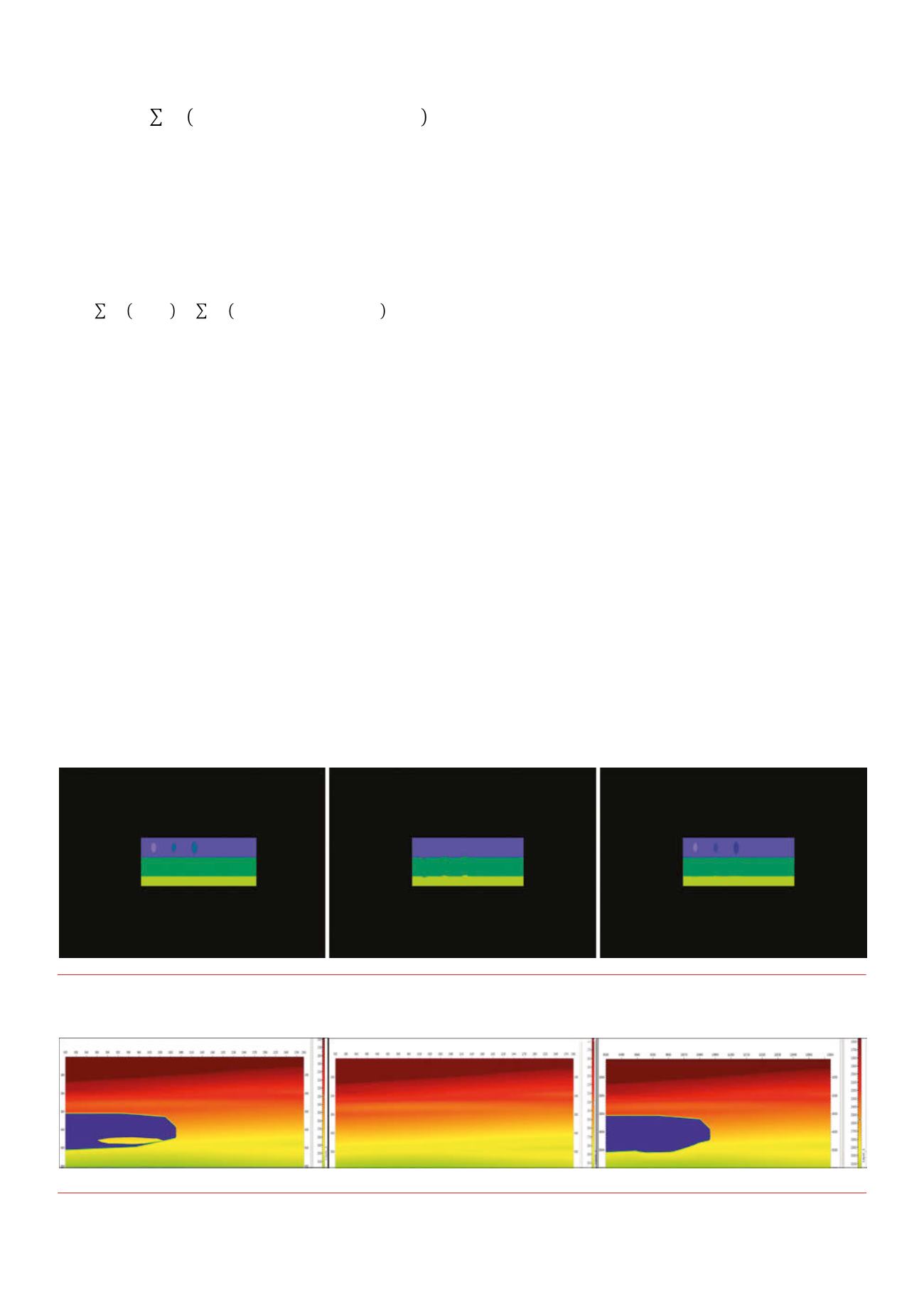
The tomography is set to update the velocity field only inside
the geobodies. Figure 4 shows the velocities along a vertical slice,
Figure 4.
Velocity along inline – original velocity (left), initial velocity (centre), output velocity fromtomography (right).
Figure 5.
Original velocity (left), sediment velocity (centre), salt flooded velocity (right).


