May 2016
Oilfield Technology |
29
application and the project needs. For example, if the seabed
is soft, the cable may be buried deeper than in rocky, hard
soil environments, where covering the cable or pipeline with
rocks can provide an alternative for protection. Throughout
any application, the need to protect the cable is of paramount
importance, due to the threat of external damage.
Before planning new subsea cable networks, there are
often a number of challenges, which must be identified and
solutions found. Installation challenges include hazards
from the hostile oceanic environment, which can reach sub
zero temperatures, as well as the dangerous, high-pressure
conditions at the seabed. Strong under sea currents, stormy
seas and an uneven terrain also pose challenges for the
successful installation of any subsea cabling project,
alongside manmade threats such as trawlers and anchors
dragging on the sea floor.
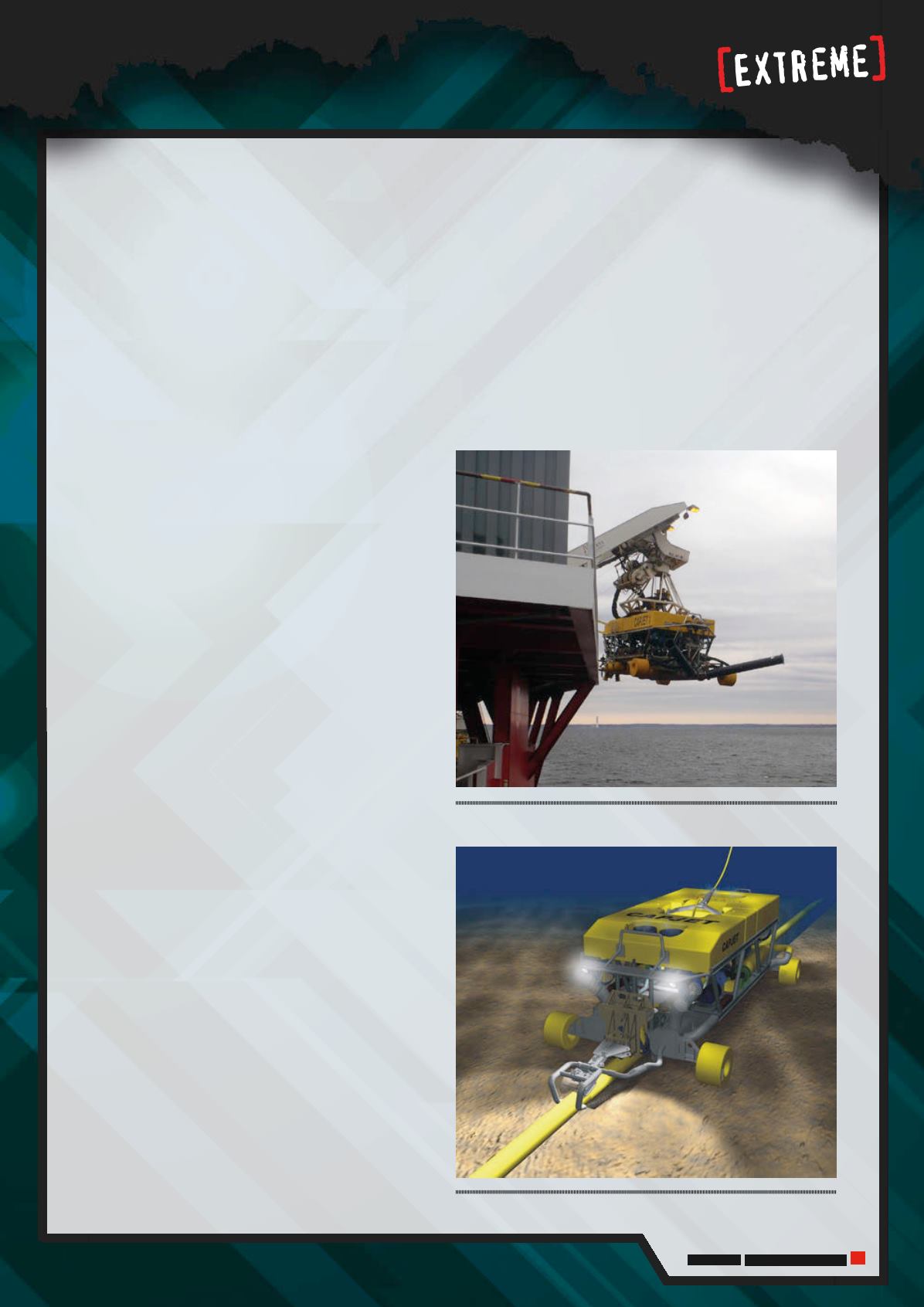
In order to combat these challenges, Nexans developed
Capjet, an ROV system that makes trenches to bury subsea
cables to protect them from hazards. The Capjet system
was designed to trench the subsea cabling remotely and
efficiently from the safety of an accompanying vessel. The
system is able to withstand depths of up to 1500 m and
was specially designed to protect umbilicals, pipelines and
power cables in extreme environments.
Capjet was developed as a diver-operated system in
1976, and acquired by Nexans in 1987. It was improved in
1991 to operate using a 1.1 MW underwater power supply.
The system has been subsequently enhanced with special
features for flexible and steel pipelines, umbilicals and
power cables, seismic cables and rock-cutting modules,
as well as equipment for covering and surveying for final
documentation.
The Capjet system is based on the principle of fluidising
seabed sediments and using water-jetting for both
propulsion and trenching. The craft is not attached to the
product to be protected and so presents no risk to the
cable or pipeline. Trenching operations can be started and
stopped anywhere along the route. Natural backfilling by
seabed sediments takes place as the trenching progresses.
The trenching units have a specially designed launch
and recovery system (LARS) to allow safe and efficient
operation from the vessel. Nexans has three identical
Capjets with control systems, each of which can be
equipped with specially designed tools.
In harder seabed conditions, the system can be adjusted
by applying additional pumping capacity and propulsion
forces enabling the Capjet to penetrate harder materials
and trench in increasingly hostile and rocky environments.
In areas where it is necessary to trench through rock, the
system can be adapted to replace the water jetting swords
with hydraulically powered, diamond tipped rock-cutting
tools.
The Capjet system is the preferred alternative to heavier
equipment that can cause damage to cables, umbilicals
and subsea installations. No forces are applied to the cable,
umbilical or pipeline during the operation. The system has
trenched 10 000 km of cables, pipelines and umbilicals
without product damage.
In the past, the systems have been successfully used
on the Ormen Lange oil and gas field, the Mallorca to Ibiza
interconnector and Statoil’s Snøhvit gas field.
Capjet often works in conjunction with Captrack and
Nexans’ cable laying ship
Skagerrak
to trench cables. Captrack
rides on rollers on top of the cable during cable laying. It is
able to track the precise position of the cable and its tension
using depth sensors, altimeters and inclinometers. The system
is also able to steer the cable in deep waters, while divers can
lay the cable in shallower waters.
Figure 2.
Capjet trenching cables on the seafloor.
Figure 1.
Capjet canbe deployed fromanumber of vehicles.


