The level of built-in design margin, contingency for system
redundancy and reliability testing is commensurate with
the consequence.
This type of testing is commonly known as
environmental testing and can take many forms:
Ì
Replicating extreme vibrations to testing contact
impact.
Ì
Simulating the desert with high temperatures and
corrosive sand.
Ì
Replicating a subsea environment with extremely
low temperatures, changes in pressure (with varying
water-depths) and the corrosive nature of salt water.
An appreciation of product survivability in extreme
environments requires careful consideration during the
design phase.
In the naval defence sector, this testing includes salt
water testing and temperatures that replicate the freezing
Atlantic and warm waters of the Gulf of Mexico. The
similarities to the requirements for testing subsea oil and
gas environments are obvious.
Over the last 30 years, Albacom Ltd has supplied
electronic components to the defence and aviation
industry – these are tested to withstand the most extreme
conditions. To ensure quality and reliability, components
and assemblies are tested according to the environment
in which they will eventually serve. Military products have
certain environmental requirements, which are dictated
by internationally recognised military standards (MIL
standards). These standards require different levels of
testing, ranging from destructive testing of prototype
units to ensure it is fit for purpose (qualification) to a
reduced level of screening for each production unit,
giving confidence in product performance but without
overly stressing or consuming product life.
Amongst other methods, environmental
test data helps meaningful prediction of the
mean time between failure (MTBF). When
combined, these different elements afford
confidence in the product’s capabilities,
without 100% destructive testing
(verification).
There is a clear distinction between
qualification and verification. When
designing components, sub-assemblies or
complete systems for critical applications,
initial prototype units are usually subjected
to a qualification process with stringent
environmental testing scenarios. Once a
design is qualified, the serial manufacture
is subject to continuous verification to
ensure quality, reliability and importantly,
repeatability of the qualified design. This
is a tried, tested and widely recognised
methodology for product supply into any
extreme environment and is prevalent in defence and oil
and gas industries alike.
Challenging conditions
In the oil and gas sector, operators are drilling in waters
deeper than ever imagined. The complexities of drilling
and innovative approaches continue to mould this
dynamic industry. Regardless of approach, there is one
certainty; operations are encountering higher pressures
and greater environmental extremes than ever before.
In the case of testing pipelines, extreme conditions are
proving even more challenging. With technology such as
coiled tubing drilling, a traditional approach is no longer
the only option. The design of subsea systems must be
thoroughly tested prior to commissioning to ensure they
are fit for purpose, but above all, are safe for the workforce
using them and the environment in which they are placed.
Before the system is delivered to site, it can be tested at
Albacom’s facility in Dundee that offers a number of testing
capabilities:
Ì
Thermocycling is commonly used in qualification,
verification and accelerated life testing. The ability to
test extreme temperatures (-55˚C to +100˚C) makes it
well suited to testing electrical components that will
be used in the assemblies of fighter jets.
Ì
3-axis vibration testing replicates the shock loading
and continuous vibration levels experienced in the real
world. Historically, single-axis, single-shaker testing was
the method of choice. However, complex, multi-axis
motions are characteristic of field environments. The
more realistic a vibration test can replicate the field
environment, the more value it offers in the product’s
verification process. Testing all three axis simultaneously
can reduce traditional test times by two-thirds and more
closely duplicate real-world vibration environments.
May 2016
Oilfield Technology |
37
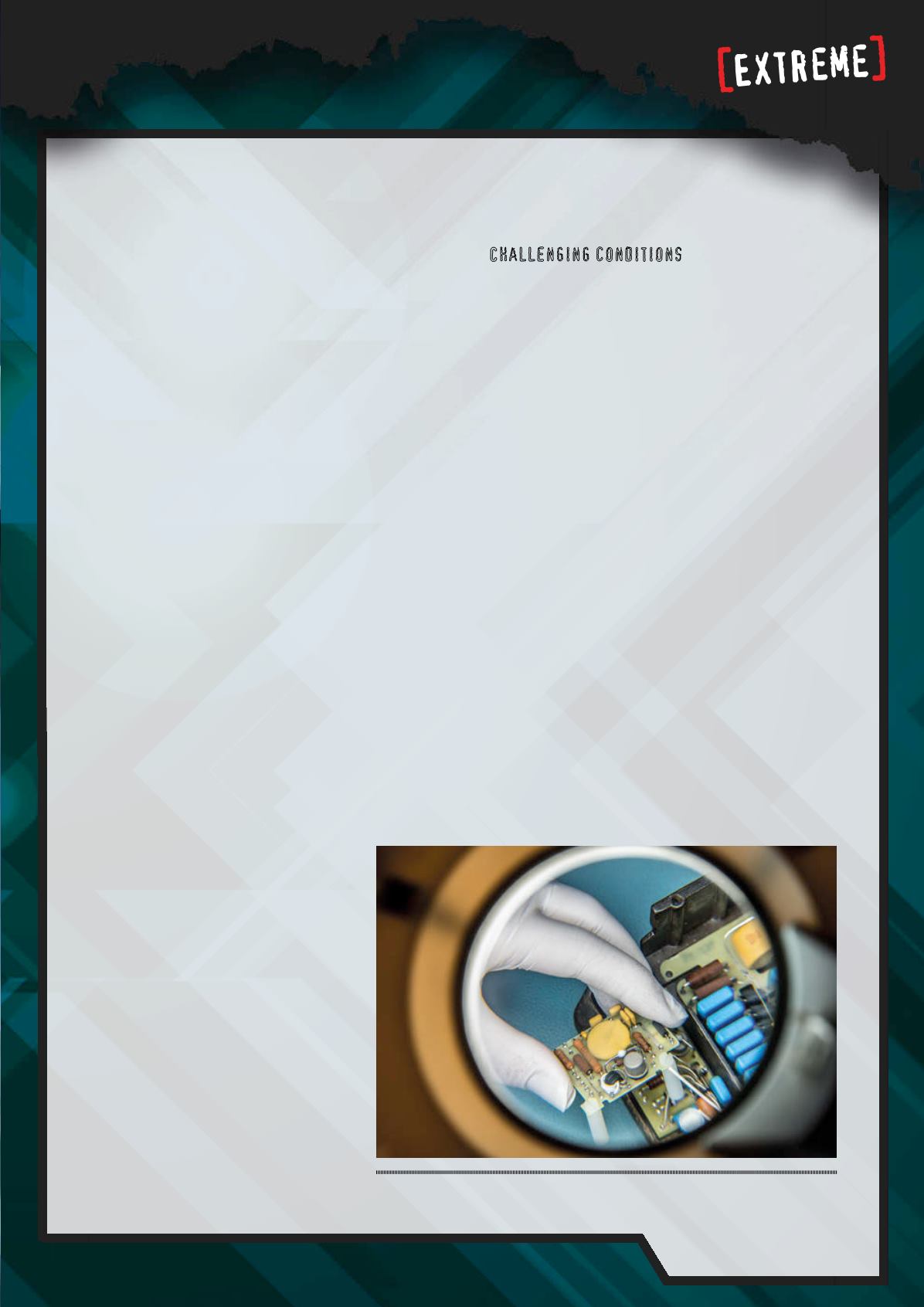
Figure 1.
Assembly of a high voltage power supply.


