46 |
Oilfield Technology
May
2016
While efficiencies and advancements in rig technology and
downhole tools have enabled faster drilling, the increasing
complexity and lengths of these wells has introduced additional
casing running challenges, resulting in more time spent on
completion activities. Finding ways to improve run-ability in these
types of wells is the key to shortening run times and unlocking the
significant cost savings operators are searching for.
While there are many factors that can contribute to casing
string run-ability, an often-overlooked variable is the impact of
centralisers in the horizontal and build sections of ERD wells. The
traditional view of centralisers as a tool for providing borehole
standoff, while still important, does not fully address the casing
running challenge or efficiency opportunity that they may create.
In extreme cases, improper centraliser implementation has been
shown to cause running challenges during well construction that
considerably increase non productive time (NPT) and drive up
the overall costs of completing the well. Operator adoption of
practices that focus on how to avoid or mitigate these challenges
by application-specific selection and placement of centralisers
can counteract this effect, enabling higher confidence in reaching
target depth (TD) with lower NPT and hence significantly reduced
overall completion costs.
Volant has been working closely with Operator D&C teams
to ground-truth and evolve an applications engineering method
for its robust rigid-body centralisers that combines application
specific pre- and post-run torque and drag modelling and
interpretation with a centraliser placement strategy for minimising
drag, particularly in high-compression situations typical of
longer-reach wells. This technically founded approach is designed
to help overcome common industry casing and liner running
challenges and has, in some cases, significantly reduced the costs
associated with completing each well.
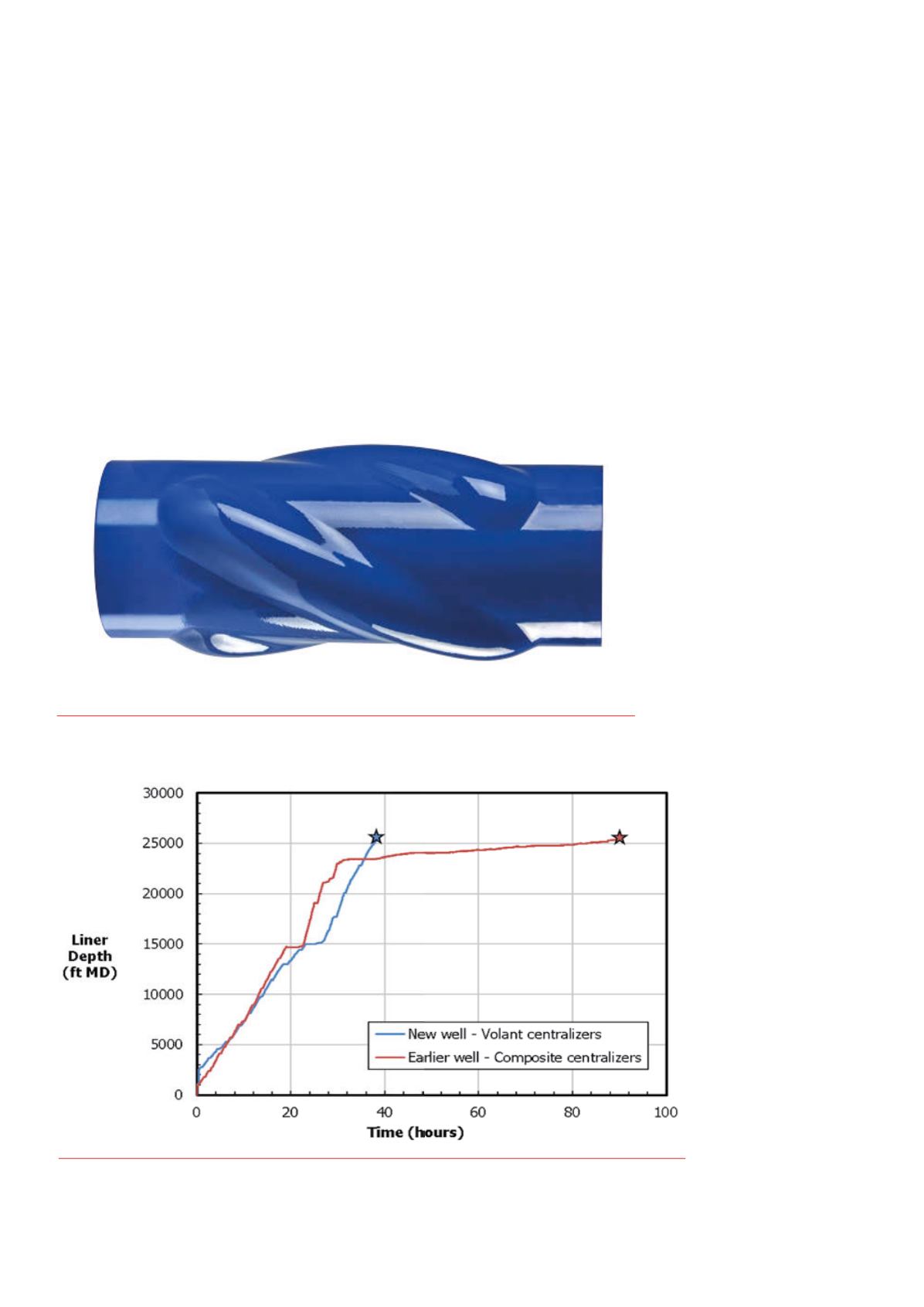
Casestudy
The clearest demonstration
encountered thus far of the value
gained (time saved) through an
appropriate application-specific
centralisation strategy occurred
in a challenging US onshore
(Bakken) shale application. The
operator was having challenges
running 4 ½ in. liner in an
extended reach well, particularly
in the last 2000 ft. Along with
significant buckling-related running
challenges, the customer was using
a composite rigid centraliser that
was breaking apart downhole. By
replacing the composite centraliser
product with a one-piece steel
centraliser and coupling it with an
appropriate centraliser
placement strategy, the
customer was able to
reduce liner running time
on an offset well by more
than half of the previous
run: 39 hours compared to
91 hours, a 57% reduction
in run time.
The supporting
evidence in this case,
and many others since,
show that a holistic view
of casing running costs
should be adopted and
that it is appropriate to
focus on the net benefit of
practices and equipment
that can reduce the overall
number of NPT incidents
and better equip operators
for subsequent wells. This
means factoring reduced
NPT likelihoods into the
Figure 2.
Liner run time saved onan ERDwell after switching to theHydroFORMcentraliser andusingan optimised
placement strategy.
Figure 1.
Volant HydroFORM™ centralisers aremanufacturedusing hydroforming technology that utilises
high pressurewater to precision formtubular steel into a variety of customisable shapes andprofiles.


