42 |
Oilfield Technology
May
2016
enough to capture market share. Thinking more progressively is
required to gain a competitive advantage and remain relevant in
this market.
Companies that are well positioned with ongoing research and
development have the opportunity of not only capturing market
share but creating new markets entirely. Product development
can follow a number of different avenues, such as evolving current
product offerings, selling into adjacent trade or developing
revolutionary, industry-changing technology. These all present their
own sets of challenges in development and in bringing the products
to market.
This is where targeted client companies must utilise technology
adoption as an ideal solution given the new product can reduce
costs, maintain or even improve performance and safety. A stable
market may not provide the needed impetus for a company to
diverge from the standard offering that has been tried and tested,
which typically follows in line with the mantra ‘this is how we have
always done it.’
However, a volatile market can pressure users to look for
low-cost or more efficient alternatives, thus creating a window of
opportunity for revolutionary change.
Companies able to proactively innovate, initiate and integrate
will not only survive, but capture long-term market share for when
the industry makes its eventual upturn.
Productsdeveloped;markets reacted
Tesco Corporation has demonstrated the ability to recognise market
shifts and demands, proactively plan for them and be prepared to
provide solutions.
The company’s development of the portable top drive was the
evolution of a product originally designed for the offshore market
niche. Adapting this archetype of an easily transported top drive for
land applications allowed the company and its customers to begin
capitalising on the efficiency gains of offshore technologies.
Such efficiencies also allowed for drilling and reaming with
double and triple stands, thus eliminating the need to ‘pump out
singles’ or ream in with the Kelly and chain can. Any reader who has
experienced this will know that the nonproductive time, waste of
drilling fluid, worker fatigue and general mess created by pumping
out or reaming in the hole with singles is a painful reminder of past
inefficiencies.
Furthermore, the portable top drive allowed for more on
bottom circulating time by replacing the Kelly bar with a short
quill and safer drilling and tripping operations with mechanised
components such as the pipe handler.
Today, the top drive remains a staple in any high-efficiency,
new or upgraded rig and is a centrepiece for complimentary
products that, as a whole, make the rig the state-of-the-art machine
it is. From automated drilling products that allow the driller to
set toolface while sliding to programmes that sense drill string
torque changes and modify RPMs, the top drive is the heart of the
automated drilling process.
Several years later, the Casing Drive System™ (CDS) was
developed to augment the top drive for running casing. At a time
when mobile top drives were quickly gaining traction for drilling
on land rigs, the company saw the potential to utilise the top drive
for running casing in the hole. The development of the CDS tool
enabled a safer and more efficient casing running operation, while
allowing the driller to rotate, circulate and reciprocate the casing
string simultaneously. This product was a key component in the
casing while drilling process.
The creation of the CDS lead to more automation and increased
safety being achieved on the rig floor. Since its invention, many
other companies have created similar products, producing what are
more popularly known in today’s market as casing running tools,
(CRT).
Today’smarket –openforopportunity
Creating a platform to introduce both revolutionary and
evolutionary concepts to market is a well-balanced equation honed
through time. There are certain risks associated with bringing a new
idea to market. Will the market understand how to capitalise on the
technology? Will the product be accepted? Is it best to be first to
market? These questions must all be carefully considered in order to
successfully plan and execute a new or remodelled product launch.
Balancing a new product portfolio to coincide with an array of
product improvements has been undertaken by Tesco Corporation
in the past. Now, the company looks to continue this strategy by
adapting its casing running services to better fit today’s market
and creating new equipment to aid in the automation of pipe
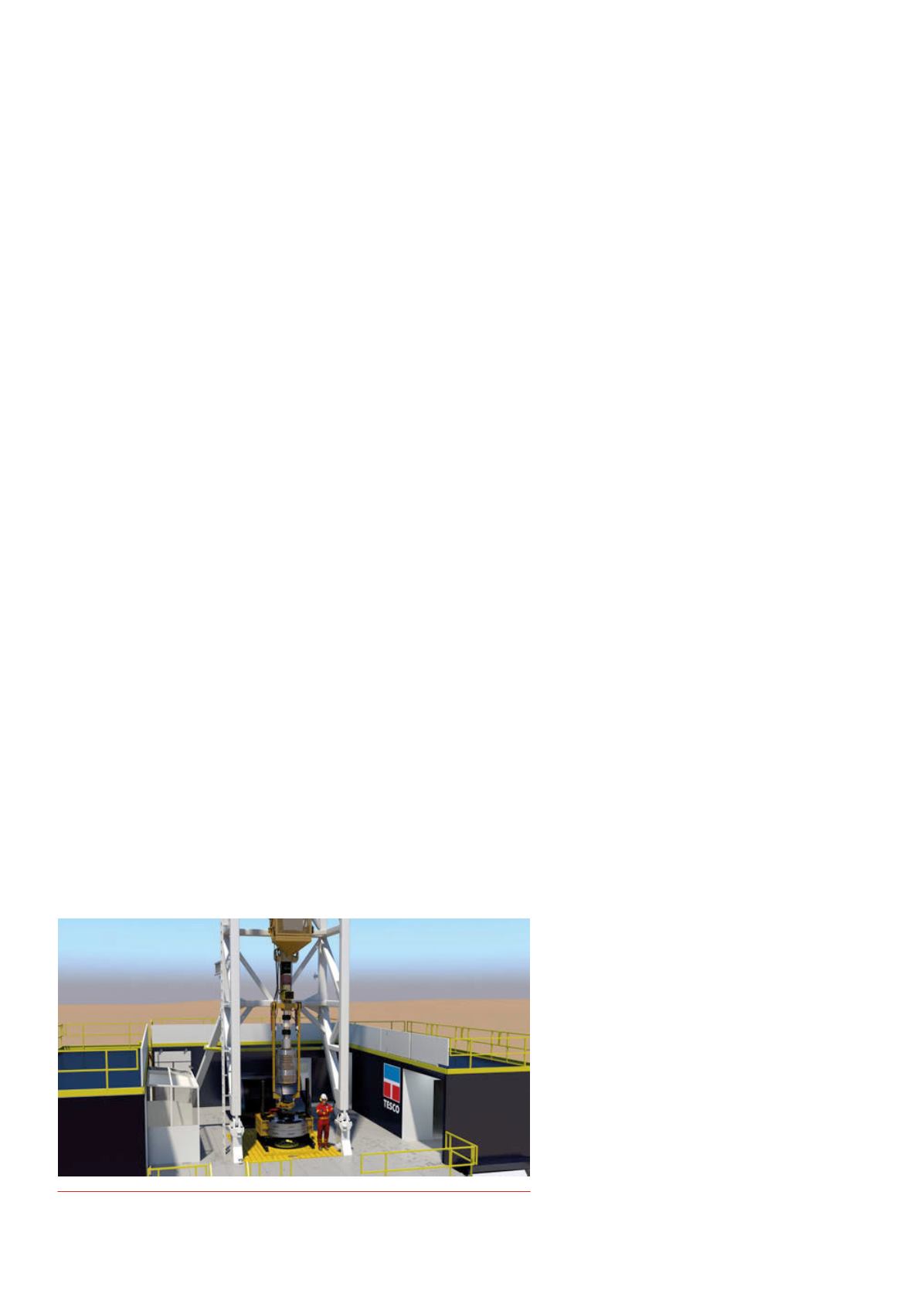
handling. Two of these new products, the Pipe Drive System (PDS)
and the Differential Speed Disengager (DSD) utilise new methods
of handling drill pipe which is expected to be an advantage to the
drilling industry.
The PDS, meant to modernise the drilling process, connects
below the top drive and engages with drill pipe on the outside
shoulder of the tool joint instead of engaging the saver sub
threads. Main components of the PDS include a set of dies that
allow for torque transfer from the top drive, an internal elevator
that supports the full string load and a unique sealing system that
ensures a sealed fluid path for drilling liquids. With the
PDS, gone are the days of screwing into a connection
when the top drive is high in the mast. Instead, the tool
simply lowers over the drill pipe and quickly engages,
enabling drilling to continue within seconds.
For tripping operations, since the PDS can engage
directly with the drill pipe, no rig floor personnel are
required to latch elevators, increasing the overall safety
of rig operations. The ability to circulate while tripping
is an additional advantage of the PDS, helping to reduce
the risk of kicks.
For drillers looking to maximise and lengthen the
lifespan of their equipment, the PDS reduces thread
engagements with both the drill pipe and the saver
sub, thus preserving the integrity of the connection.
Repairing and rethreading connections are kept to
a minimum, and the lifetime of the saver sub can be
Figure 1.
PipeDrive SystemandDifferential SpeedDisengager ona rig floor.


