34
|
Oilfield Technology
May
2016
laboratory analysis. However, if a problemalready exists, such as
water ingress froma seal leak, then the time frames involved with
laboratory testing leaves the thrusters open to the risk of further
damage. This can easily escalate beyond the point where simple
remedies are effective. Early warning through on-board or on-line
conditionmonitoring can allow simple corrective action to be
taken, such as off-line filtration, before it reaches the point of no
return and the expense becomes unavoidable.
Online condition monitoring
Class societies and regulatory bodies are continually defining
new andmore stringent rules for dynamic positioning and the
associatedmonitoring of thrusters. Online conditionmonitoring
data can now be used as part of the evidence presented to the
class society to extend survey intervals and to realise significant
cost savings. This on-linemonitoring takes the formof sensors
attached to the thruster, which provide a constant streamof
real time data. The operator canmonitor the condition of the
thrusters by exception, whilst they all remain in operation. In
addition, early warning of thruster damage can allow for amore
operationally efficient approach tomanaging the use of redundant
thrusters. Drilling contractors can be required to have one or more
redundant thrusters available at all times. If alerted to an issue
with a thruster at a very early stage, before damage has occurred, it
can be switched out to become a redundant thruster, allowing for
corrective action to be scheduled for a convenient time.
To be truly effective, onlinemonitoring systemsmust be
tailored to spot the common, fastest acting problems specific to
the equipment type. For example, thrustermonitoring systems,
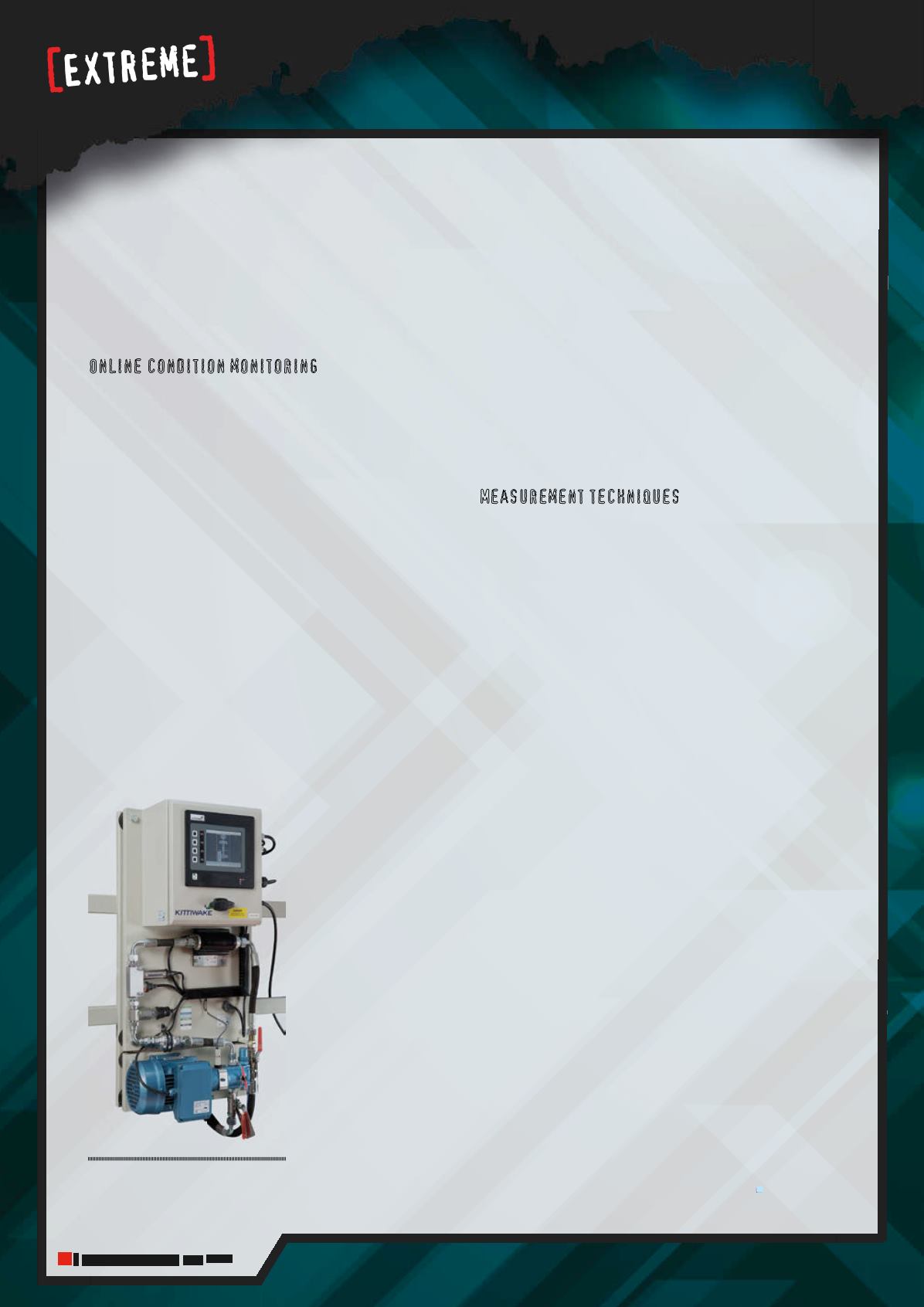
such as Parker Kittiwake’s ThrusterSCAN, can detect wear debris
frombearings and gears, lubricant degradation, andwater from
seal leakage. With 85%
of bearing failures being
traceable to the lubricant
or contaminants therein,
continuallymonitoring
these parameters covers
the common thruster
failuremodes. At a time
when budgets are being
cut and older assetsmust
now run for longer, these
systemsmust also be
simple to retrofit at sea,
withminimal disruption to
operations.
In other applications,
in extreme environments
where access to
equipment is high-risk
and complex, sensor
technologies can be
applied to determine
if abnormal wear
is occurring. Sensors, like theMetallicWear Debris Sensor (MWDS)
fromParker Kittiwake, provide a real time analysis of the size, number
and composition of thewear debris particles passing through a
lubrication system. Using a combination of inductive coil technology
and smart algorithms, the sensors provide a particle size distribution
count of ferrous and non-ferrousmetalswithin the lubricant. By
alerting to changes in the rate of generation or the size of themetallic
particles, abnormal wear can be identified early and corrective
maintenance scheduled.
Conditionmonitoring sensors should also be designedwith the
unique challenges of the key equipment types inmind. To allow for
accurate and safemonitoring in hazardous environments such as
top drives, theMWDS not only needs to be certified for ATEX Zone 1,
but manufactured using seawater and drillingmud resistant
materials, whilst alsominimising the risk of any falling objects.
Measurement techniques
Finally, themeasurement techniques and data reporting of new
sensor technologies should be independently verified, to ensure
they are genuinely beneficial. The American Society for Testing and
Materials (ASTM) provides an independent third party standard
that defines best practice in effectivemetallicwear detection (ASTM
D7917-2014). With the specification and scope of the standard
defined and set by ASTM, D7917-2014 recognises the importance
of on-linewear debris detection andmonitoring in preventing
unplannedmaintenance. The standard ensures that sensors comply
with the highest standards in accuracy and quality, providing
assurance to the operator that the information provided can be
trusted and help informthe actions taken tomitigate damage.
Where proactive conditionmonitoring becomes vital is for
safety-critical assets such as blowout preventers (BOPs). The control
fluidswithin the systemmust be tested for a number of parameters
including cleanliness, particle contamination, bacterial growth
and the concentration of glycol. If contaminated fluid is transferred
through the umbilical to the BOP, it could cause the valves to stick.
It is therefore essential in guaranteeing the safety of the equipment
to ensure that the fluid is proven tomeet themanufacturers
specifications. Again, some testing offline is adequate, but for critical
parameters such as fluid cleanliness, it ismore appropriate to
combine offline testingwith an online sensor.
By employing a combination of traditional techniques and
modern advances, operators can ultimatelymake the difference
between damage control and financial catastrophe. In extreme
environments, that oftenmeans keeping engineers out of harm’s
way, and preventing significant expense further down the line.
Eachmethod of monitoring the condition of critical equipment
has its benefits, and operators need to assess whichmethod or
combination of methods best suits their needs and budget. Today’s
technology is a long way from the days of relying on human eyes
and ears to assess damage (often long after it had escalated past
a critical point). In an industry where the onus is increasingly on
reducing costs, whilst increasing operational efficiency, extending
the lifespan of assets and driving improvements in safety, it is no
longer acceptable to ‘do what we have always done’.
Figure 3.
Parker Kittiwake
ThrusterSCAN.


