30
|
Oilfield Technology
May
2016
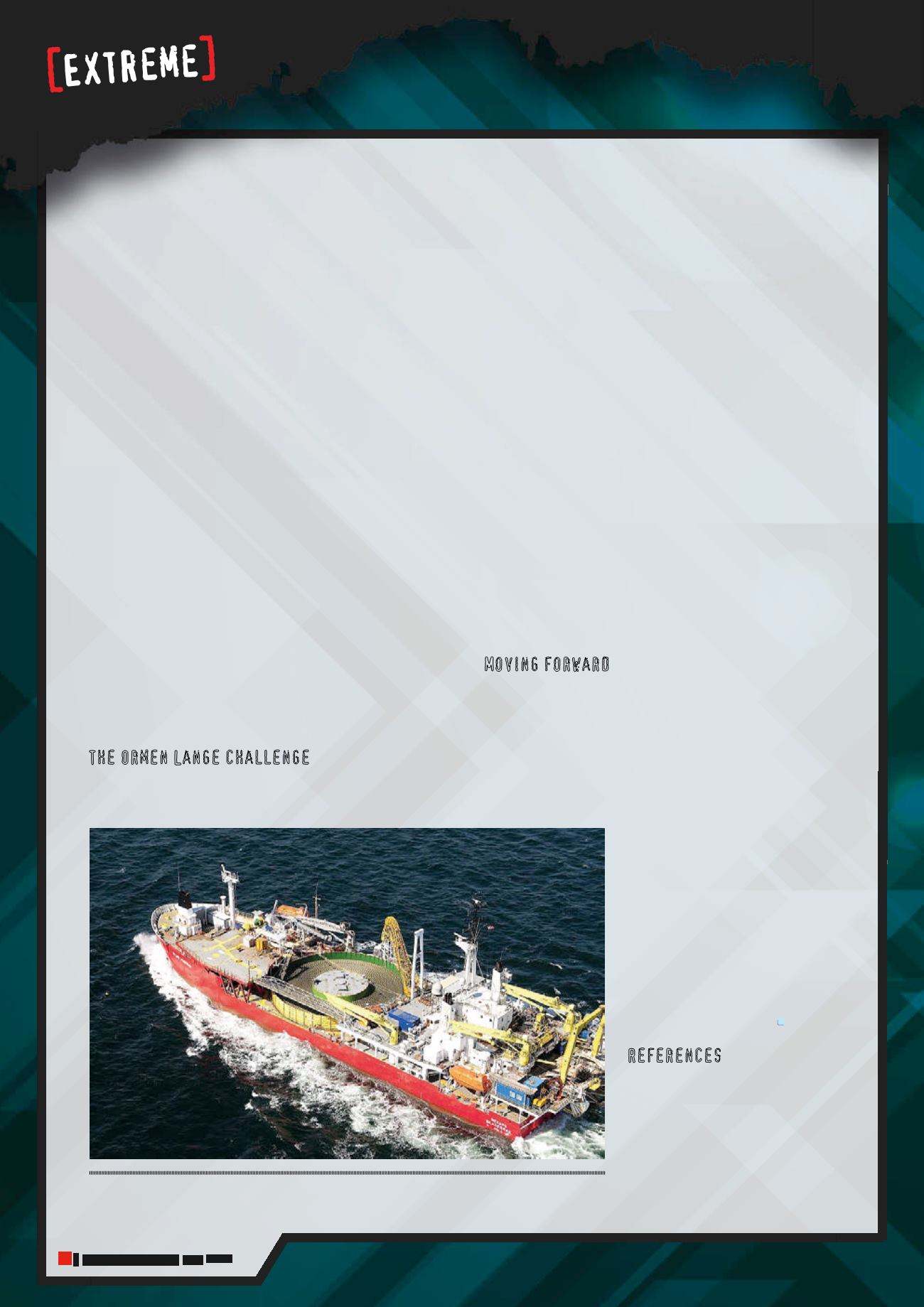
Capjet and Captrack are often launched from
C/S Nexans Skagerrak
, a purpose-built ship designed
specifically for the transport and installation of submarine
high-voltage power cables and umbilicals. One of only
two ships of its kind,
Skagerrak
has a turntable capable of
carrying 7000 t of cable and has multiple cranes on board.
Further equipment can be fitted to the ship depending on
the project, such as instruments for cable repairs, submarine
cutting and retrieval of damages sections, piggyback laying
and simultaneous laying of two cables.
The software on board includes a computerised cable
laying control system and a sophisticated global positioning
system (GPS). The control system monitors information from
lay speed and lay length sensors, one lay wheel load sensor,
one cable top angle sensor and one high-accuracy echo
sounder.
Skagerrak
has been involved in some of the most
advanced projects in the world including Ormen Lange,
NordLink, the first HVDC interconnector between Norway
and Germany, and the 170 km Maritime Link in Canada.
In response to changing requirements of customers,
the ship underwent a US$10 million upgrade in Liverpool.
A pre-fabricated hull section was installed which increased
the length of the vessel by 12.5 m. The upgrade also included
an additional accommodation module, taking the number
of cabins onboard from 49 to 60. A new work deck took the
on-deck storage area from 900 m
2
to 2000 m
2
. The project
extended the ship’s service life and increased autonomy at
sea.
The Ormen Lange challenge
One particular project demanded the development of a
more rugged piece of equipment. Ormen Lange is the largest
gas field on the Norwegian continental shelf. It is located
100 km off the northwest coast of Norway at a water depth
of 850 m to 1100 m. The project to connect the gas field with
Norway and the UK was started in 2007. For the project, the
cable had to traverse a 300 ft cliff face made up of extremely
rough terrain caused by the Storegga Slides. Trenching was
required to install the cables and the pipelines.
Another challenge came from the long unsupported
weight caused by laying cables at this depth. It created
significant mechanical strain. A special combination of
sheathing and insulating materials helped Nexans meet
this challenge. The strength and coefficients of expansion
were at the correct value to prevent water getting into the
cable during installation.
Nexans’ Spider, a member of the Capjet family, was
specially developed for the Ormen Lange project. The Spider
was designed to be able to level the seabed at depths of up
to 1500 m in order to install the cable in rough terrain.
The Spider combined water jetting and suction to remove
large volumes of soil using a dredging head on an extendable
arm to cover the operational area. The telescopic tool arm
was also equipped with purpose-designed dredging heads,
cutting tools and other intervention tooling. The project was
a success, with energy exchange commencing in 2008.
Moving forward
The number of pipelines, umbilicals and power cables in
use has grown as energy demands have grown. Installing
these cables on the seafloor has posed a number of
challenges. Trenching these pipelines and cables under the
seafloor provides an effective way of protecting them from
strong currents, freezing temperatures, trawlers and other
hazards.
With a growing population
building pressure on the oil and
gas industry, innovation will be key
to serving contemporary energy
requirements. Through designing
advanced cable-laying ships and
accompanying ROVs, engineers
will be able to tackle the energy
challenges of the future as resources
are identified in increasingly hostile
environments, requiring boundaries
to be pushed even further.
References
1.
/
statistics/279100/number-of-offshore-
rigs-worldwide-by-region/
2.
perspectives/2015-oil-gas-trends
3.
/
print/volume-72/issue-5/equipment-
engineering/trenching-dredging-
systems-aid-subsea-installations-in-
problematic-soils.html
Figure 3.
Skagerrak
at sea.


